


In the tall acacias and sunlit grasslands of southern Africa, there’s a flicker of movement—quick, grey, and curious. A young vervet monkey skitters along a branch, pausing just long enough to glance back at the troop. Below, a mother cradles her infant against her chest as she scampers between trees. The world of vervet monkeys is quiet and chaotic all at once, a rhythm of survival, play, watchfulness, and community.

These monkeys—Chlorocebus pygerythrus—are among the most widespread primates in southern Africa. Ranging across countries like Namibia, Botswana, Zimbabwe, South Africa, and Mozambique, they’ve adapted to a surprising range of environments: dry savannah, riverine forest, thorn scrub, even the edges of urban neighborhoods. Wherever there is food, water, and a good lookout tree, vervets thrive.


With their soft grey coats, black faces fringed with white, and long, graceful tails, vervets are easy to spot but rarely still. They live in troops that can number anywhere from 10 to over 50 individuals, often made up of a handful of adult males, many females, and their young. Within that group is a complex web of relationships—mothers and daughters, rival males, adolescent jokers, and cautious elders. Each vervet, from the tiniest infant to the sharp-eyed alpha, plays a role in the life of the troop.
The structure of a vervet troop is largely matrilineal: females stay with the group they were born into, while males leave when they reach adolescence, usually around five years old. These transitions are not always easy. A young male striking out on his own must navigate unfamiliar territory, avoid predators, and try to integrate into a new troop—a process that can take months and involves no small amount of posturing, risk, and occasional rejection.
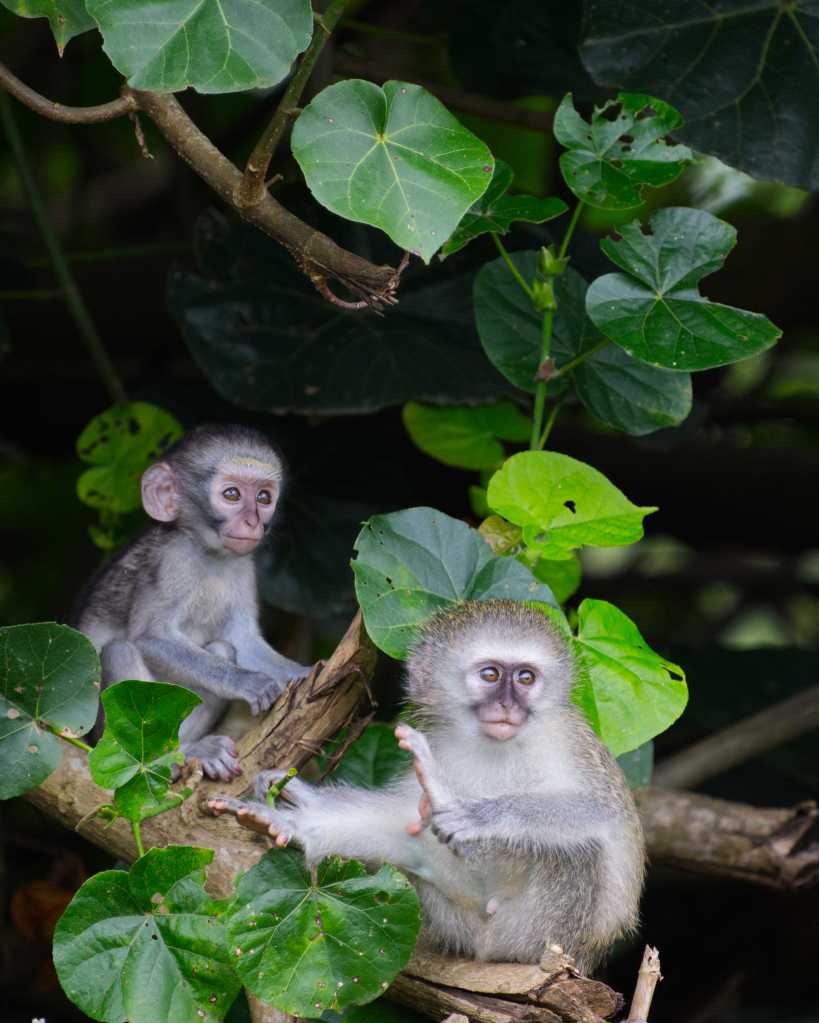
But for the females, rooted in their birth group, life revolves around family. Mothers are deeply attentive to their infants, carrying them close for the first few weeks of life, grooming them constantly, and keeping a watchful eye as they begin to explore the world. Other females—particularly juveniles or childless adults—often attempt to “borrow” babies, sometimes causing minor squabbles as they jostle for a chance to carry the troop’s newest members.

As the sun rises higher and the air warms, the troop moves. Youngsters chase one another across the open grass, leaping over logs and tumbling in mock battles. Their play is not just for fun—it helps build social bonds, teaches agility, and mimics the real conflicts they’ll one day face. Adults keep a loose perimeter, scanning the trees and skies for signs of danger. Leopards, snakes, and martial eagles all see vervets as potential prey. The monkeys’ defense? A sophisticated system of alarm calls, each one specific to the type of threat.
A leopard near the ground? A rapid bark sends the troop scrambling up trees. An eagle overhead? A distinct coughing call signals everyone to freeze and scan the skies. These calls aren’t just reflex—they’re learned. Young monkeys must figure out which sounds mean what, and who in the troop can be trusted as a reliable alarm-giver. It’s one of the many signs of the vervet’s intelligence and social awareness.

Vervet diets are omnivorous and opportunistic. Fruits, flowers, seeds, leaves, insects, bird eggs, and even the occasional lizard make up their meals. They’re especially fond of marula fruit when it’s in season, and can often be seen in the canopy during the early morning, plucking and chewing contentedly. Their fingers are surprisingly dexterous, and when foraging, you’ll often catch a mother breaking a pod open with one hand while balancing her baby with the other.

And yet, for all their adaptability and intelligence, vervets are increasingly finding themselves in conflict with the modern world. As towns expand and farmland replaces bushveld, the monkeys have learned to exploit new opportunities—raiding gardens, stripping fruit trees, even tipping over bins in search of leftovers. In urban and suburban areas, vervets have become remarkably bold. They’ll slip through an open window to raid your kitchen, making off with bananas, bread, or anything not locked away. They’ve been seen strolling straight into restaurants through open doors, leaping onto tables, snatching food, and vanishing just as quickly.

This boldness often doesn’t go over well. Farmers may label them pests, and in some places, they are trapped, relocated, or worse. But the vervets persist. In towns and villages, they navigate human spaces with uncanny precision scaling fences and bypassing locked gates with practiced ease. They raid with surgical precision—one monkey acting as lookout, another opening the gate latch, a third opens a cupboard or pops off a Tupperware lid looking for the prize within. Their cleverness is their greatest survival tool—and the very thing that so often causes them to be misunderstood.

Watching a troop from a respectful distance, you begin to notice the small gestures that define their lives. A mother softly pulling a burr from her infant’s fur. Two brothers wrestling in the grass, stopping only to groom each other with surprising tenderness. An elder female perched high in a tree, still and silent, watching the horizon.

As the day begins to cool and shadows stretch across the veld, the vervet troop begins to settle. Babies nestle close to their mothers, juveniles quiet down, and the adults gather in the high branches where the night feels safer. There is the soft rustling of fur against leaves, the occasional chirrup of a young one not quite ready to sleep, and the stillness of animals who have done this many times before.
In the gentle dusk of southern Africa, the vervet monkeys close out another day—social, agile, curious, watchful, wild. Always wild.
 The Footstep Chronicles
Leave a comment