

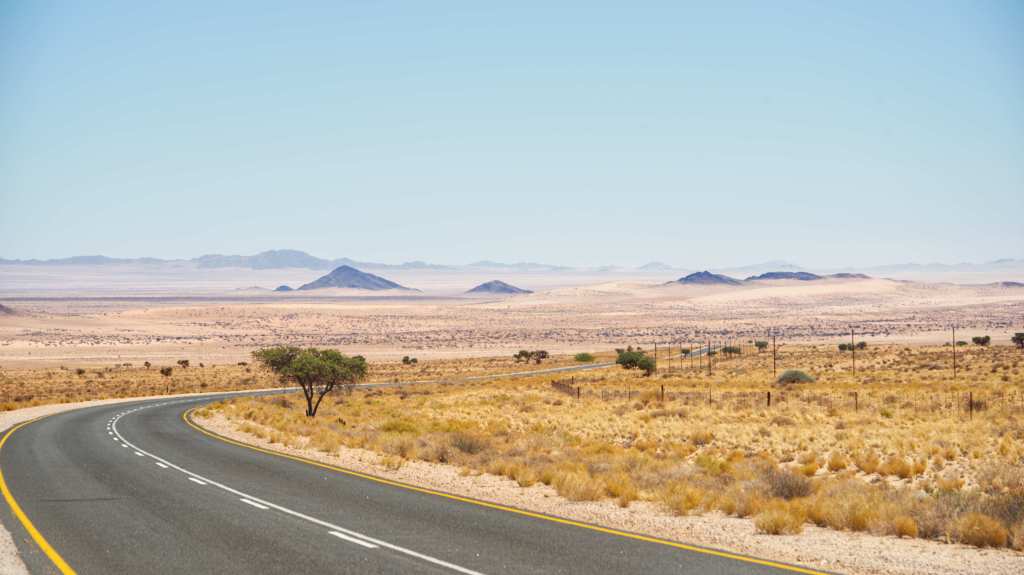
The road unspools like a ribbon of faded tar through the oldest desert in the world. The Namib stretches out before you — an expanse of gold and ochre, of wind-scoured rock and silence so deep it hums in the ears. It is not an emptiness, though it feels like one at first glance. It is something vaster than emptiness — a fullness of space, time, and light that seems to swallow you whole.
There is a strange comfort in that swallowing. To drive through the Namib Desert is to disappear into a landscape that does not care who you are or where you come from. It existed long before the idea of a road, before the notion of maps, before names. It will exist long after the last treadmark has been erased by the wind.
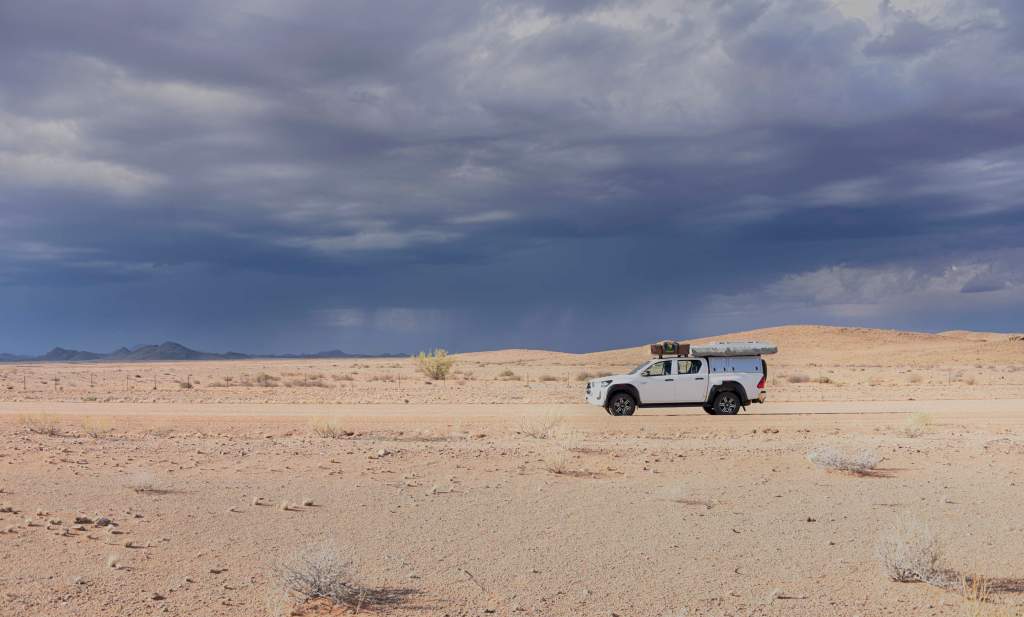
Stretching for nearly two thousand kilometers along Africa’s southwestern coast, the Namib Desert runs from southern Angola, across the entire length of Namibia, and down into the Northern Cape of South Africa. It is considered one of the oldest deserts on Earth — some parts have been arid for at least 55 million years. To the west, the dunes meet the cold Atlantic Ocean in a haze of fog and wind; to the east, they rise into gravel plains and rugged mountains that seem to dissolve into the horizon. This vast corridor of sand and stone forms a living border between land and sea — a place so immense that the idea of distance itself begins to lose meaning.

The Namib is a desert of many textures and shifting forms. It begins in the south, where it falls into the vast canyons and stone valleys of the Ais Richtersveld Transfrontier Park. Here the dunes give way to rock, and the land hardens into ridges and gorges cut deep by time. The greatest of these is the Fish River Canyon, second only to the Grand Canyon in scale. Its walls drop in sheer terraces, carved by water that now flows only for a few weeks each year. The rock is ancient — schist and dolerite, dark and layered, burnished to copper by the sun. The air is dry and sharp, filled with the smell of dust and stone. When the light moves across the canyon, it reveals bands of color like the pages of geological time — ochre, iron, violet, grey. Even in stillness, the landscape feels restless, as if the earth is remembering its own making.
Around Ais, where the Fish River finds its end in a cluster of hot springs, the desert softens just slightly. The canyon walls open into plains strewn with boulders and low, silver-green shrubs that cling to cracks in the rock. In the cool of morning, the air smells faintly of mineral water and acacia sap. To the west, the mountains begin to flatten into gravel plains, their flanks eroded into vast fans of loose stone. This is the Namib at its most elemental, where water and fire, stone and wind have shaped the land into something both desolate and eternal.

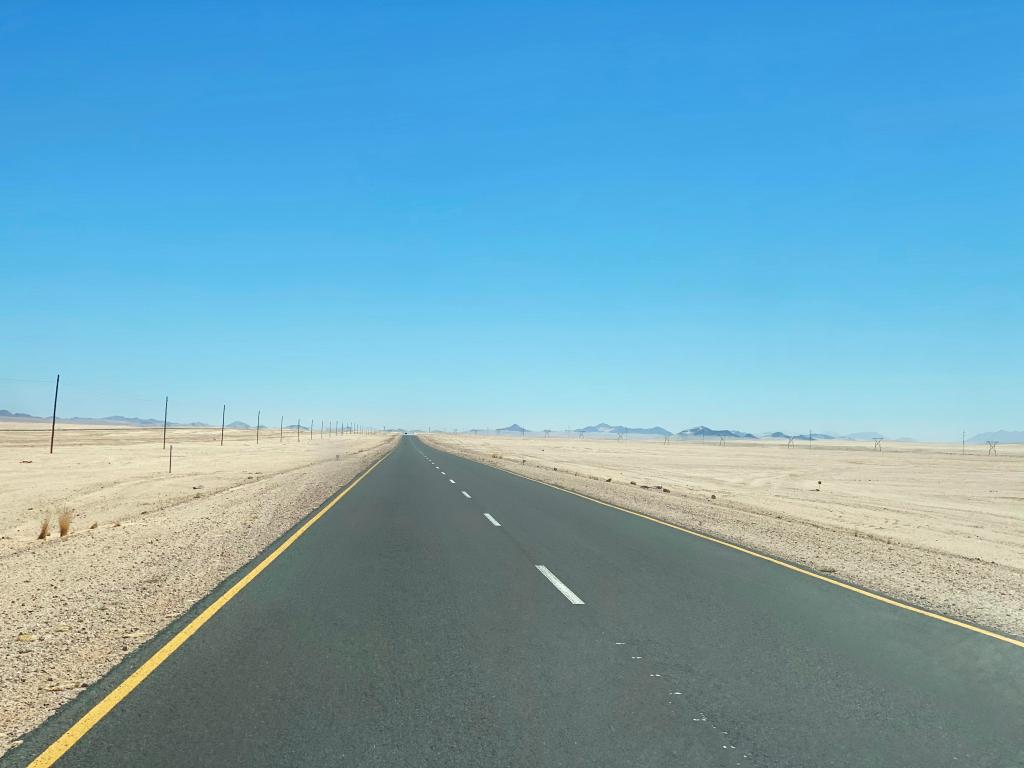
Leaving the rocky canyons and rugged ridges of the south behind, the desert gradually softens into broad plains and rolling gravel flats. The highway from Aus toward Lüderitz stretches straight across this expanse, cutting a steady line through heat and light, the horizon shimmering in mirage. Running nearly parallel to the road is the old railway line, originally laid during the German colonial era, abandoned for decades, and now fully reopened — carrying manganese and other ore from the interior mountains down to the coast. Alongside both the road and rail, power lines march steadily across the plains: newly erected high-voltage towers standing tall and the dark wooden poles of old, all threading together human persistence with the desert’s quiet vastness. Occasionally, a slow freight train appears in the distance, its steel glinting in the heat haze, moving like a measured pulse through the shimmering landscape.
The road, the railway, and the power lines are companions in this emptiness — small threads holding steady against the desert’s scale. Between them, the land stretches unbroken: low salt pans flash white under the sun, gravel flats extend into the far horizon, and the faint blue silhouettes of the Tiras Mountains rise to the east. When the wind shifts, the faint vibration of the rails mingles with the hum of tires and the whisper of electricity in the lines, creating a rhythm that feels like the desert’s heartbeat itself.
Toward the coast, the terrain becomes more uneven. The sand grows thinner, replaced by ridged hills of dolerite and limestone. These are landscapes stripped bare — no trees, no shelter, only the architecture of geology itself. Wind has carved strange patterns into the stone, hollowing small alcoves and smoothing boulders into shapes that look sculpted. Here and there, low shrubs take root, their roots deep enough to reach moisture trapped beneath the crust. These plants — the nara melon, the euphorbia, and the occasional hardy camelthorn — are proof of the quiet tenacity of life. They cling to existence where logic says they should not.
Somewhere near Garub, between Aus and Lüderitz, the land softens into a series of plains. It’s here, in this unlikely place, that the wild horses of the Namib live — descendants of animals brought here a century ago, cavalry horses abandoned during the First World War, and left to fend for themselves. How they survived is still a mystery, but they did — and now, generations later, they have become as much a part of this desert as the dunes themselves. They are one of only two herds of wild horses in all of Africa.
They move in small herds, usually no more than a dozen, and you can sometimes see them from the roadside if you’re lucky — dark shapes against the pale sand, grazing on the sparse tufts of dry grass. They gather around the Garub waterhole, sustained by a small well maintained by conservationists. Their survival here is a miracle of adaptation. They graze on the dry, brittle grasses that cling to the edges of the plains, sometimes digging into the sand for roots or licking dew from the rocks at dawn. They have learned to live by the rhythm of scarcity — to move, to rest, to wait.
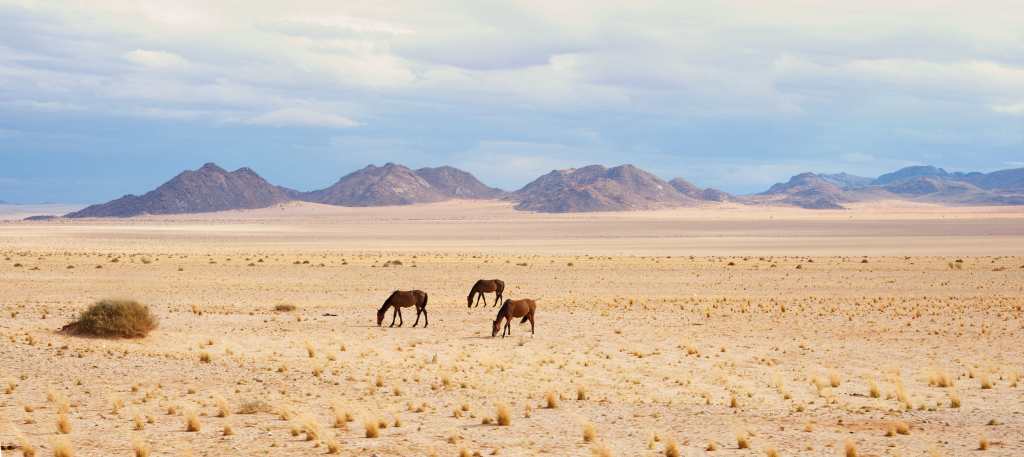
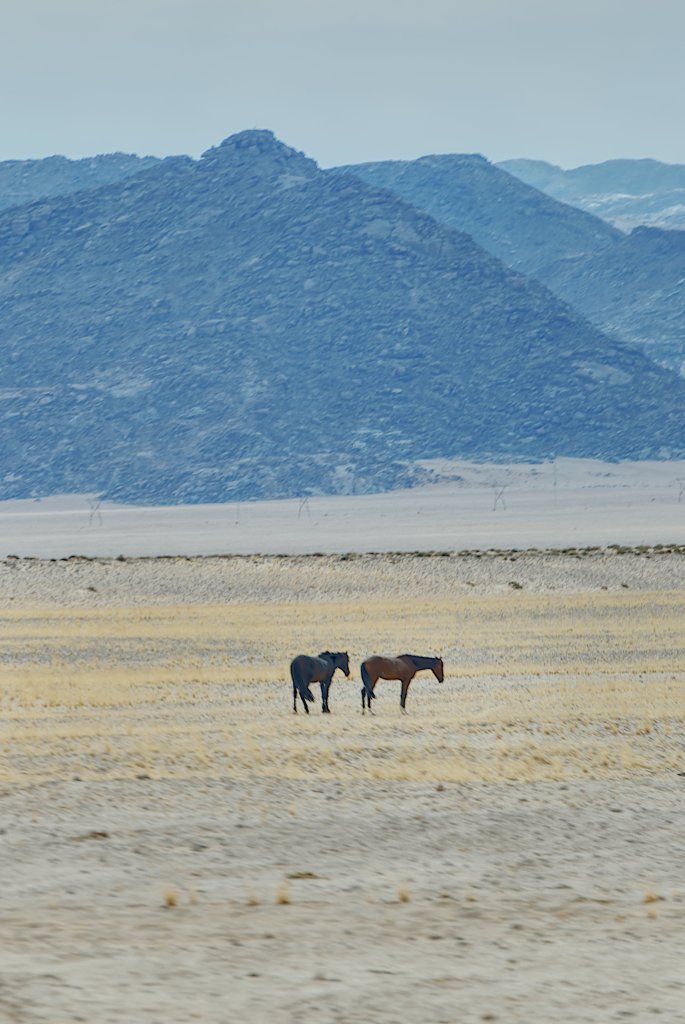
The horses have become symbols of the Namib itself: wild, enduring, and strangely graceful. There’s a dignity in their survival. They are not tame, not entirely wild, but something in between — a reminder of what adaptation truly means.
You begin to understand why travelers seek them out. It’s not just for the beauty of the sight — though that is reason enough — but because they represent the same stubbornness that draws people here. The will to continue, despite the heat, the dust, the distance. To exist in a place that seems determined to erase you. This is, after all, a landscape that does not hold on to much.
Near Garub, not far from where the horses gather, stands a single abandoned railway building — a station long out of use, its roof half-collapsed, its walls scoured by wind and sand. Its walls, once whitewashed, have peeled to reveal layers of stone and mortar the color of bone. The windows are hollow now, the frames stripped bare, and the doors hang crooked from rusted hinges. This is a place long since forgotten by the trains that once stopped here. Around it, the sand has started to rise against the foundations, as if the desert is slowly reclaiming the structure, one storm at a time. When the light shifts in late afternoon, the building throws a long, crooked shadow that stretches far across the gravel plain, a ghost of its own endurance.

Farther up the road, half-buried near a dry culvert, an old truck lies tilted in the sand — its body once a pale green, now mottled with rust and sun-bleached to. The tires have cracked and buckled, the rubber brittle from decades of heat and wind. You can still make out a faint trace of paint on the door, maybe a name or a number, long since erased. When the wind blows, it carries sand through the cab and out again, a soft exhale that sounds almost like breath. It feels less like something abandoned than something absorbed — another relic the desert has decided to keep.

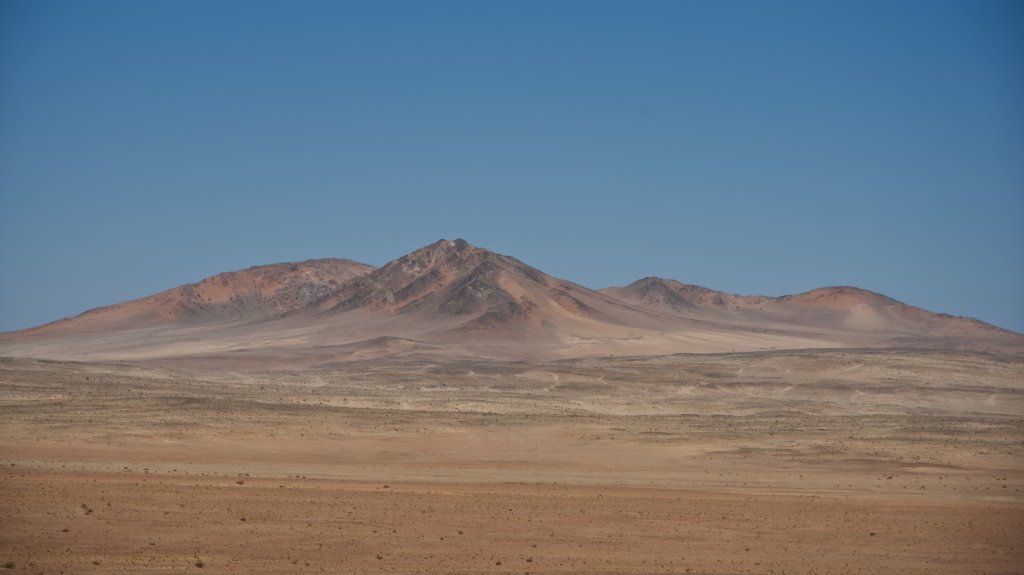
In the Garub region, the landscape unfolds as vast, flat plains of gravel and pale sand, stretching endlessly beneath the expansive sky. Intermittently, small rocky outcrops emerge from the otherwise level terrain, their dark, weathered surfaces contrasting sharply with the surrounding earth. These isolated formations stand as silent sentinels in the arid expanse, their jagged profiles etched by time and the relentless desert winds. Between these outcrops, the land remains open and unbroken, offering a sense of solitude and timelessness that defines this part of the Namib Desert.

Farther north of Garub, the desert begins to open in a subtly different way. The plains stretch wide and flat, still punctuated by small rocky outcrops rising from the gravel and sand, but the soil here holds a little more moisture, and patches of hardy grasses and low shrubs dot the landscape, stubbornly clinging to life after the rains. The road runs straight through this expanse, a ribbon of blacktop guiding the traveler past scattered stones and tufts of green, the desert simultaneously vast and intimate. It is a quiet stretch, where the scale of the plains becomes clear and the promise of change looms ahead, as the pavement will soon give way to the winding dust and dirt roads that lead deeper into the heart of the northern Namib.

The last of the pavement fades behind you, the smooth blacktop ending in a scatter of sand and dust. Ahead, the mountains rise faintly out of the haze, their outlines shifting in the heat, blue at first and then deepening to violet and iron-gray as you draw closer. The air grows cooler, carrying the scent of dust and distant rain, and the wind picks up, weaving thin veils of sand that trail across the track like smoke. There’s a stillness in this approach — a feeling that the road is not so much taking you somewhere as leading you deeper into the desert’s own heart, where stone and sky seem to meet without boundary.

Before long, the dirt gives way to gravel, and the first foothills begin to rise, dark and ridged with age. The road climbs gently between them, weaving through narrow passes and dry washes that cut through the stone. The wind carries a cooler breath here, edged with the scent of rain that once fell and the green that lingers after it. The mountains themselves are not towering, but they command a kind of quiet majesty — their faces streaked with mineral veins, their shadows long and blue against the afternoon light. Occasionally, a lone tree clings to a hollow or a ridge, its roots sunk deep into the rock, a stubborn fragment of life in a place that gives so little. The road twists on, and you follow it, deeper into the heart of the northern ranges, where the desert begins to show its subtler colors.

As the road winds out of the mountains, the gravel begins to loosen again, thinning into soft drifts of sand. The ridges fall away behind you, and the dunes return, vast and sculpted by the wind. Their slopes catch the light in shades of pale tan, brushed with the faintest red — a color that seems to shift with the sun. In places, the sand shows a hint of green — small tufts of grass and hardy shrubs scattered across the flats, each a fragile echo of recent rain. A few young acacias stand solitary in the hollows, their roots sunk deep in hidden moisture. Life endures quietly, the green of young shrubs and scattered grasses, revived by the desert’s recent rains.
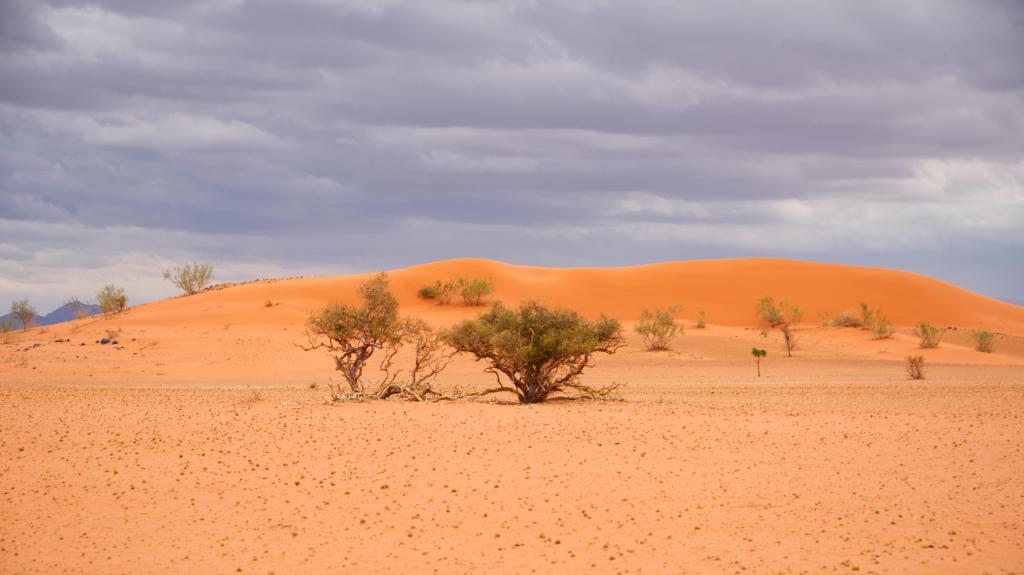
As the road continues north, the landscape gradually shifts. The towering dunes of the Namib Desert, some of the tallest in the world, begin to merge into an unbroken sea of sand. These vast dunes, their golden and reddish hues shifting with the sun, stretch endlessly, their crests sculpted by the persistent winds. Beyond the dunes lies the Moçâmedes Desert in southern Angola, where the sand continues uninterrupted, blending into the arid plains. This northern expanse, part of the Namib Sand Sea, is a testament to the desert’s vastness, its boundaries stretching well into Angola, where the sands persist, unyielding and eternal.
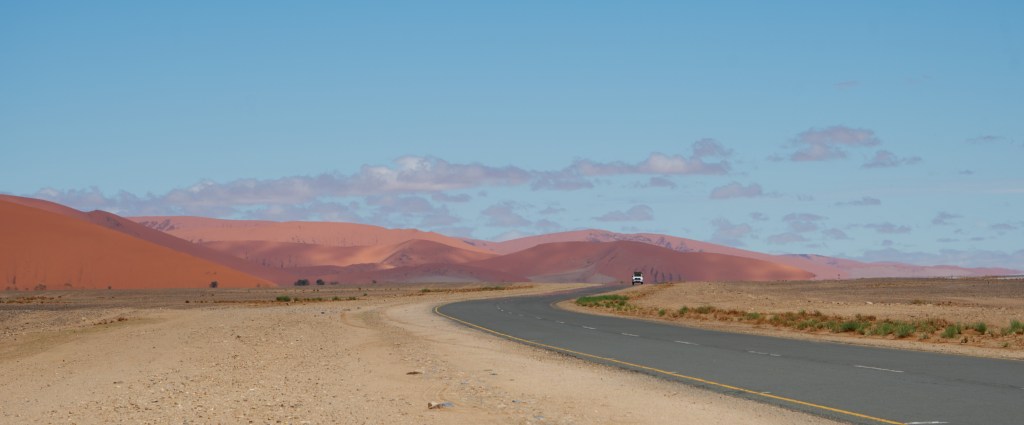
In the Namib, the desert stretches on in every direction, vast and unbroken, a place where time slows and the world feels distilled to its essence. From the rugged canyons of the south, carved by the Fish River over millennia, the landscape rises into central gravel plains dotted with small rocky hills and ridges that emerge from the flat terrain. Here, the desert is quieter, the sand thinner, and the mountains and ridges give way to long, gentle expanses of gravel, where the wind etches patterns across the stone-strewn earth. Farther north, the land transforms again into endless, wavy dunes, some reaching hundreds of meters, stretching as far as the eye can see and continuing into southern Angola. Scattered hints of green appear after rare rains, the fragile signs of life that endure in a place both ancient and ever-changing. To traverse this desert is to move through a living chronicle of the Earth itself — a landscape that humbles, mesmerizes, and quietly reminds you that even in the emptiest places, life and time persist, carried forward on the wind and the shifting sand.

 The Footstep Chronicles
Leave a comment