

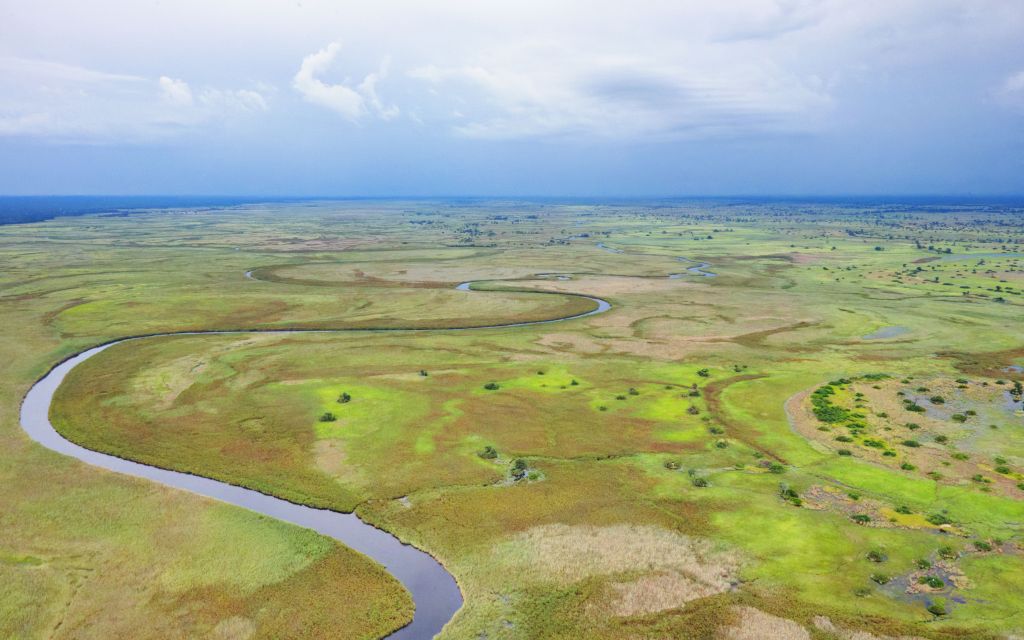
From the air, the Okavango Delta stretches across the land like a living map — more than 15,000 square kilometers of flooded wilderness at its peak, glimmering in green and gold beneath the wide Botswana sky. It is one of the largest inland deltas on Earth, a place where a river comes to rest instead of running to the sea. Its headwaters gather rains far to the north in the highlands of Angola, where summer rains spill down from rolling plateaus, and run south for a thousand kilometers. The river runs south through miombo woodland and open savannah, collecting tributaries and the slow memory of storms. Every drop carries a fragment of that distant rain. For months it flows unseen by human eyes, winding through forests of mahogany and kiaat, before slipping across the border into Namibia’s Caprivi Strip. Then, at last, it crosses into Botswana, and something miraculous happens: the land drops away and the water begins to spread.
What was once a defined river becomes a vast unfolding—channels dividing, rejoining, vanishing into floodplain and reedbed. Seen from above, it is a living map that rewrites itself with every season, a green mosaic of water and earth. This is the Okavango Delta, one of the world’s great inland wonders: a river that never reaches the sea, but instead surrenders to the desert, dissolving into the sands of the Kalahari. And during the rains, it becomes a breathing world of its own—a labyrinth of channels that glitter beneath the wings of passing birds.

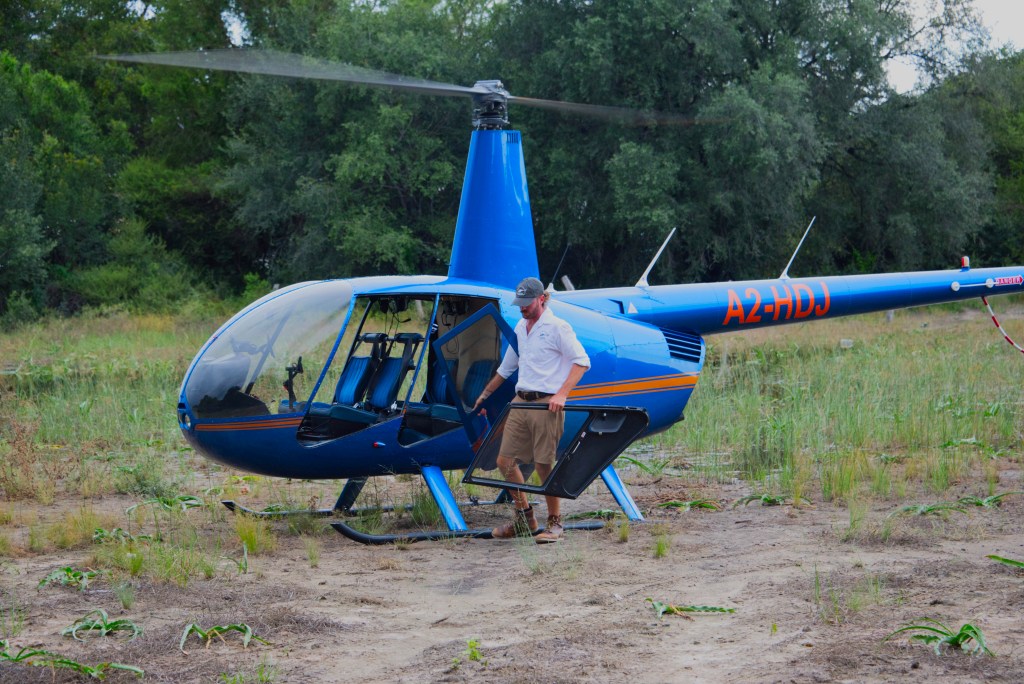
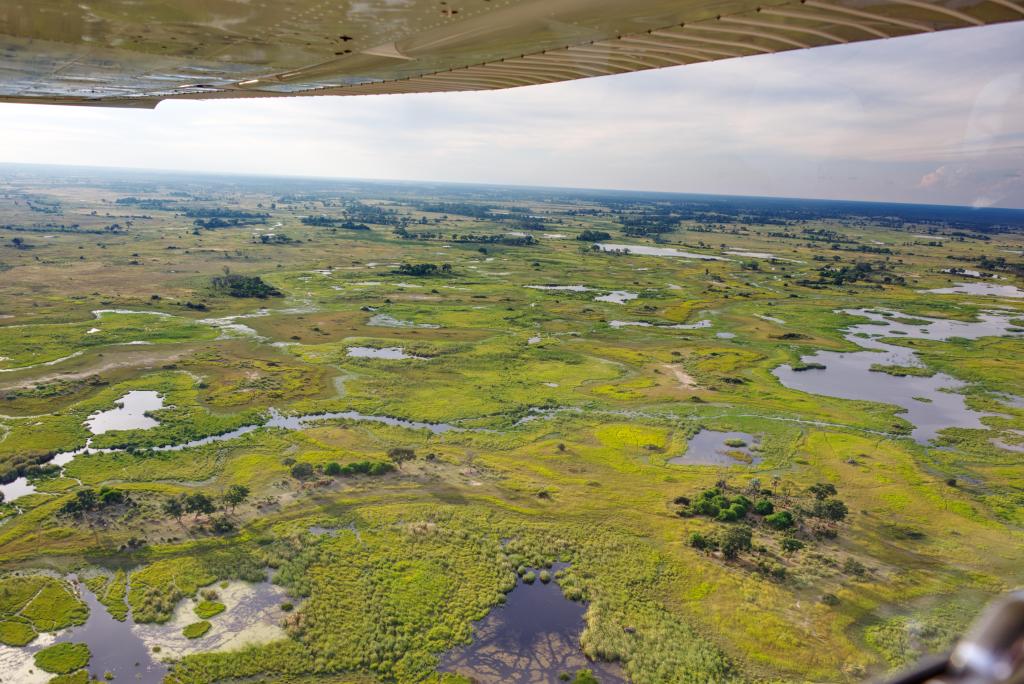
There is only one true way to understand the Okavango Delta: from the air. To see its shape, its scale, its endless unfolding, you must rise above it — into the wide heat and the weightless light. Most travelers come here by open helicopter, doors unlatched, wind pouring in as the land unrolls beneath them. From that vantage, you can see how the Delta breathes. The patterns that make no sense from the ground — the looping waterways, the fan-shaped spreads of green — resolve themselves into meaning. You can trace the slow veins of floodwater as they divide and rejoin, see herds moving like dark currents through the grass, and watch the sunlight scatter across a million mirrored pools. From above, the Okavango reveals itself for what it truly is: a living mosaic, as fluid and restless as the sky itself.

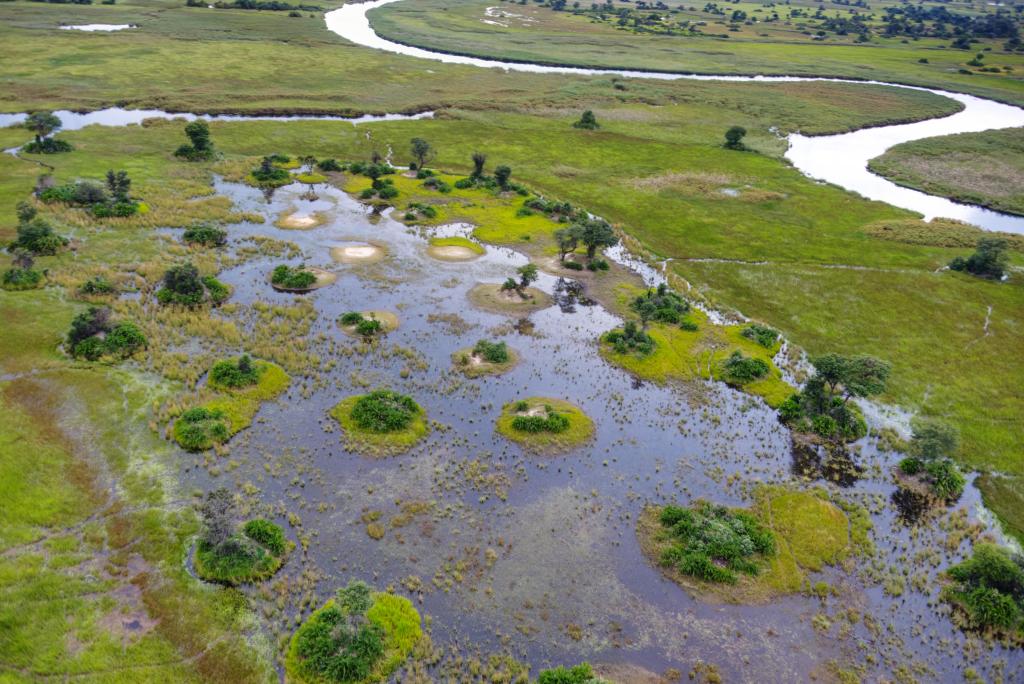
The first thing one notices from the air are the termite mounds —everywhere — small rises of pale earth catching the light. To most eyes they are just shapes in the landscape, but here, they are the foundation of everything. The termites that build them are architects of the Delta’s survival. Their towers are not only homes but islands in waiting: they hold back the water, anchor the trees, and enrich the soil. When floods return each year, the highest mounds remain dry, offering refuge for snakes, small mammals, and nesting birds. When the waters recede, those same mounds become the first to green again, spreading life outward in all directions. The Delta renews itself through these humble engineers, whose work is measured not in years, but in lifetimes upon lifetimes of patient creation.
In the flooded season, the mounds form a constellation — each one a small world of survival rising from the mirror of water. Some hold palms that mark them like sentinels, others carry groves of ancient figs where elephants feed. Even lions will rest here, waiting for antelope to pass through the shallows below. The termites, unseen within, keep working through all of it — blind, tireless, necessary. Without them, the water would have nowhere to settle, and the wilderness below would have no place to rise from.
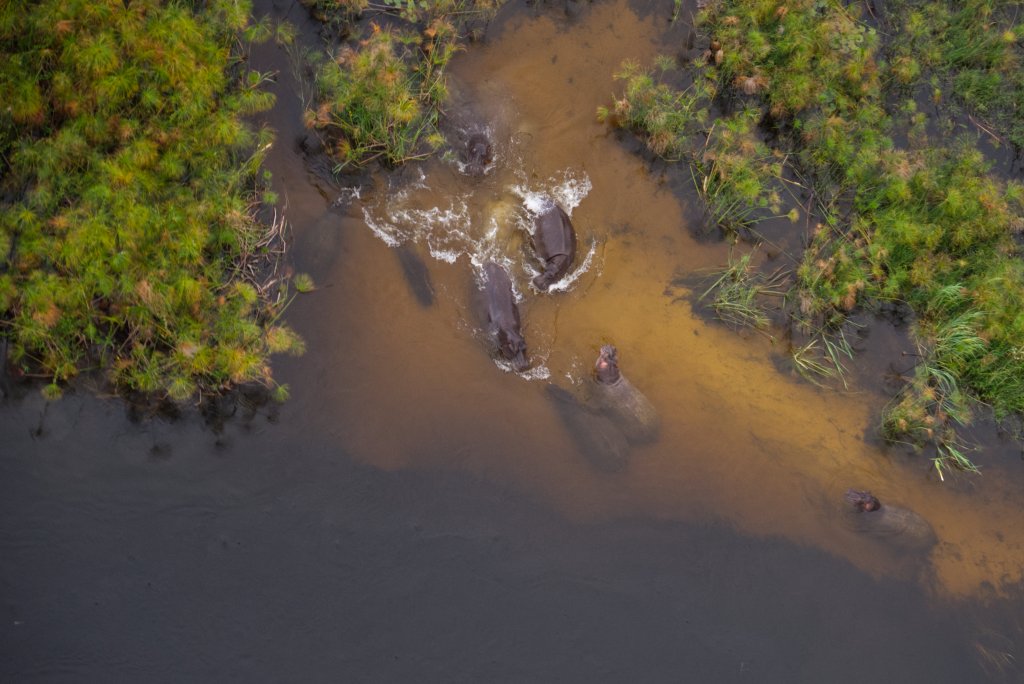
From above, the Delta’s pools and channels are alive with motion that seems, at first, to belong to the water itself. Then, with a subtle shift of shadow, you see them — the rounded backs of hippopotamuses, surfacing in slow sequence, the air trembling with their breath. They gather in families, thick-skinned and ancient, their forms rising and sinking in rhythm with the light. Some rest shoulder to shoulder in the deeper lagoons, eyes and nostrils just breaking the surface, while others drift toward the reed beds where they feed at night.
Getting higher up you can trace their movements clearly: narrow, dark paths pressed into the green, the unmistakable hippo trails that crisscross the marshes like veins. Each one is a record of passage — corridors worn smooth by centuries of the same quiet pilgrimage from safety to sustenance, from water to grass and back again. Around the edges of their pools, you can see the marks of their nightly forays: reeds broken and flattened, mud churned to a slick mirror. These are the hippos’ highways, the lifelines of the floodplain. When the rains swell the Delta, the trails become channels, carrying fresh water deeper into the reeds. Fish follow the same routes, and small creatures shelter in the ruts that remain when the waters recede. What looks from above like chaos is, in truth, order — a design born from repetition, shaped by instinct, sustained by the slow pulse of survival.

Farther out across the floodplain, the herds of elephants begin to appear — gray shapes scattered like islands within the green. From above, they move with slow, deliberate grace, tracing long paths through the shallows. Their progress is easy to follow: a thread of disturbance in the still water, a widening ripple where a calf wades too deep, the silver flash of a channel stirred by their crossing. Each matriarch leads her family along routes older than memory, carved into the Delta by generations that have walked the same trails before them. Their footprints fill with water as soon as they pass, small mirrors marking the way until the next herd comes through. In this way, the elephants write the map of the Delta, one slow step at a time.mall islands.

They are not just travelers here — they are the engineers of the floodplain. Where they pass, trees open to light. Where they feed, the forest thins and grass grows thick in its place. When the waters are high, they break through the reed beds, widening channels that will guide the next flood. Even their bodies change the landscape: trunks stirring the mud, tusks lifting branches, broad feet pressing new trails into the soft ground. The water remembers them. In the next season, those trails will become streams, those clearings will bloom. From above, the pattern of their movement is everywhere — arcs, spirals, and faint gray lines through the green — a living script written on the Delta’s surface.

When they rest, they gather beneath the trees that crown the termite islands. From this height, the scene feels timeless: massive bodies in still water, trunks lifted to drink, shadows moving gently across the grass. Calves play in the shallows, splashing with the careless joy of abundance. Around them, egrets and oxpeckers perch on their backs, following them as if drawn by gravity. But it is the elephants who give the Delta its rhythm — not in sound, but in movement, in the slow pulse of creation that their presence brings. Every island they visit, every channel they cross, becomes part of the Delta’s memory — a landscape shaped not by force, but by the persistence of life itself.

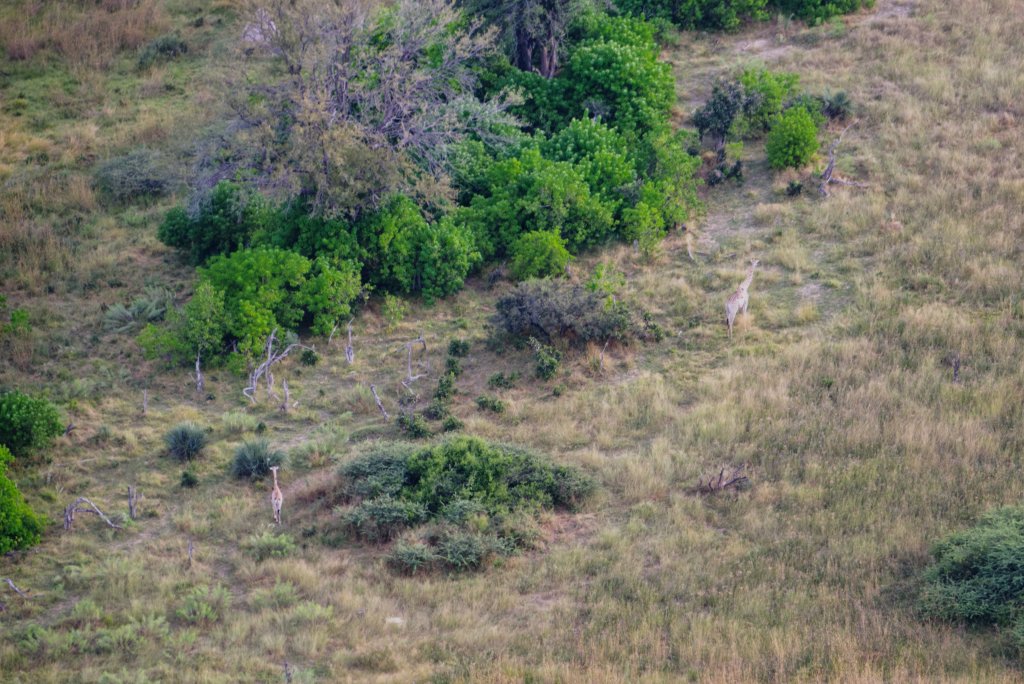
From above, the giraffes appear like brushstrokes moving slowly through the pale green of the floodplain. Their long necks sway above the canopy of acacia and palm, heads turning to pluck leaves that no other creature can reach. In the clear morning light, their mottled hides reflect the shifting colors of the trees — sand, gold, and shadow — blending them into the landscape. You can see them following narrow trails between islands, each step careful on the higher ground where the soil stays dry. From the air, their shapes stretch and bend across the open spaces, graceful but immense, like moving pieces of the land itself.
Their passing leaves subtle traces — a patch of broken leaves, a thin line pressed into the grass. When they cross from one island to another, their reflections waver briefly on the flooded plains, two worlds overlapping for a moment before the light changes. The giraffes seem to exist somewhere between the earth and sky, always moving, always watching, as if they carry the calm of the Delta within their own stillness.
Five antelopes stand cautiously in the dark, rippling waters of the flooded plains, their slender legs partly submerged as they navigate the shallow expanses. Around them, tall reeds sway gently in the breeze, rustling against the occasional ripple, while patches of vibrant green vegetation float like islands in the water. The antelopes move in quiet synchrony, alert to the subtle sounds of the wetland—the splash of a fish, the whisper of reeds, the distant call of birds. Here, in this seasonally inundated landscape, their lives are a delicate balance between foraging and vigilance, relying on the water to nourish the grass and greenery that sustains them, while remaining watchful for predators that may hide among the reeds. Each careful step reflects the rhythm of survival in a world both lush and unpredictable.

The Okavango Delta spreads like a living mosaic, channels of dark water weaving through vibrant green islands and swaying reeds. Herds of antelope, elephants, and hippopotamus move with quiet purpose, guided by the rhythm of the floods that nourish every corner of this extraordinary landscape. The water glimmers in the sunlight as it slowly journeys toward the thirsty sands of the Kalahari, disappearing yet leaving life in its wake—fertile soil, lush vegetation, and sustenance for every creature that depends on it. Seen from the sky, the delta is not just a wetland; it is the heart of Botswana, a green jewel in the dry expanse of southern Africa, sustaining life in a land where water is both precious and fleeting.
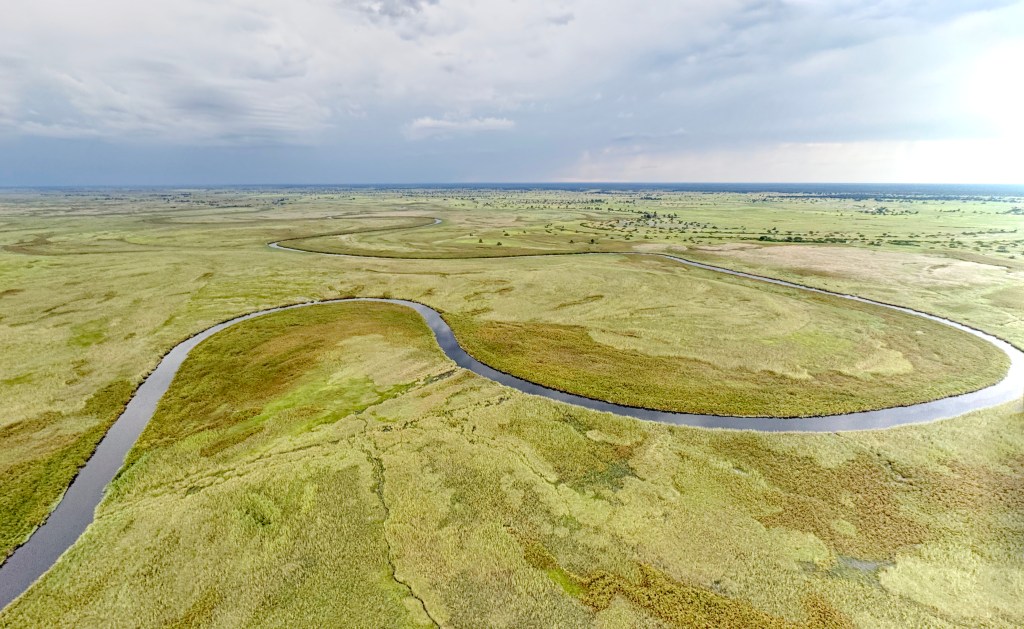
Yet even as the floods pulse through the delta, there is a sense of impermanence. The same channels that now overflow with abundance will, in the dry season, shrink and retreat, leaving isolated lagoons and parched sandbanks. The vast, watery world that now teems with life will become quieter, harsher, and more fragile, a reminder that the delta’s magic depends on the delicate balance between wet and dry. From above, it is easy to see the cycles of survival, the ebb and flow that define the pulse of this remarkable place, and to sense the resilience required to thrive in a land shaped by water’s fleeting presence.
 The Footstep Chronicles
Beautifully written and observed.
Visiting the Delta over 20 years ago remains a highlight of my life.
LikeLiked by 1 person