

London in winter is never only winter. The cold is there, yes—rolling in from the Thames, slipping down side streets, threading itself into coat linings—but it’s softened by the luminous pageantry that arrives each December. The city trades its grey cloak for a shimmer of gold, silver, electric blue. It becomes something mythic, as though the streets themselves remember old tales: Dickensian ghosts and Victorian shopfronts, carols whispered on frosted breath, lanterns swung by hands long gone.

Walking London at this time of year is mesmerizing. The city feels truer. Softer. More willing to reveal pieces of itself it hides in summer. The Christmas lights don’t simply illuminate—they narrate, guiding the wanderer from one chapter to the next. It begins subtly—a cool sharpness drifting along the river, a pale sun struggling to climb above rooftops, a clarity in the air that reveals the architecture without adornment. The city doesn’t immediately sparkle. It first simplifies, quiets, exhales. Only then does it begin to glow.

Cross the riverfront at Battersea, winter daylight moves across the Power Station with a quiet authority. The vast brick structure rises clean and confident beneath the pale morning sky, its chimneys cut into the air like exclamation points left by history. The district here feels open, newly polished, and distinctly modern, but winter softens it. Light spreads across the plaza in thin sheets, catching on coats and windows, filling the space with a bright stillness that asks passersby to slow down.
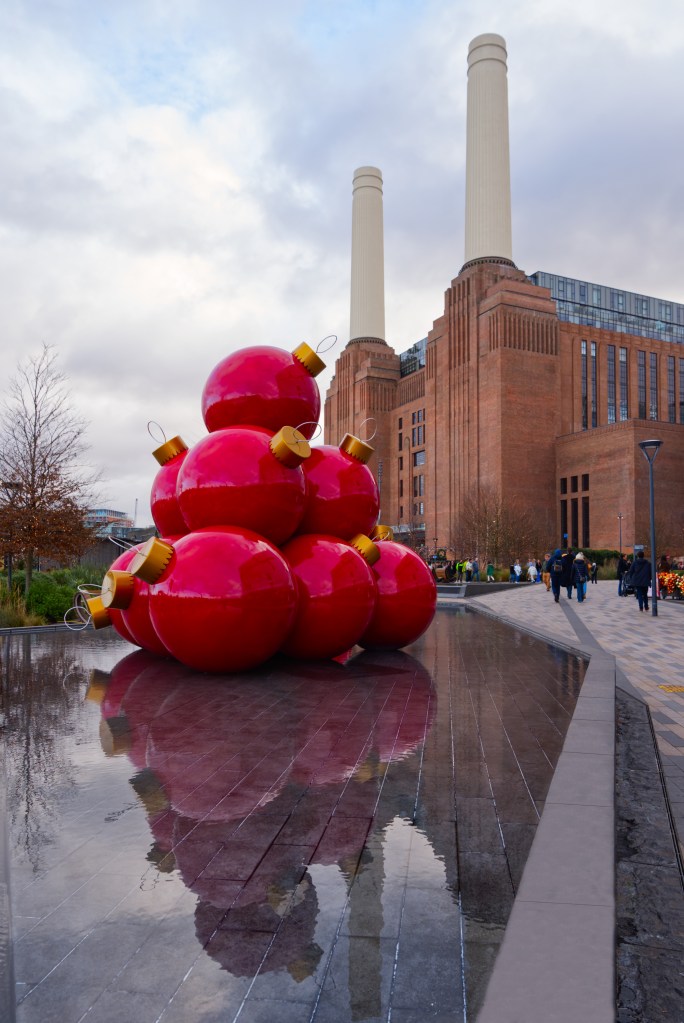
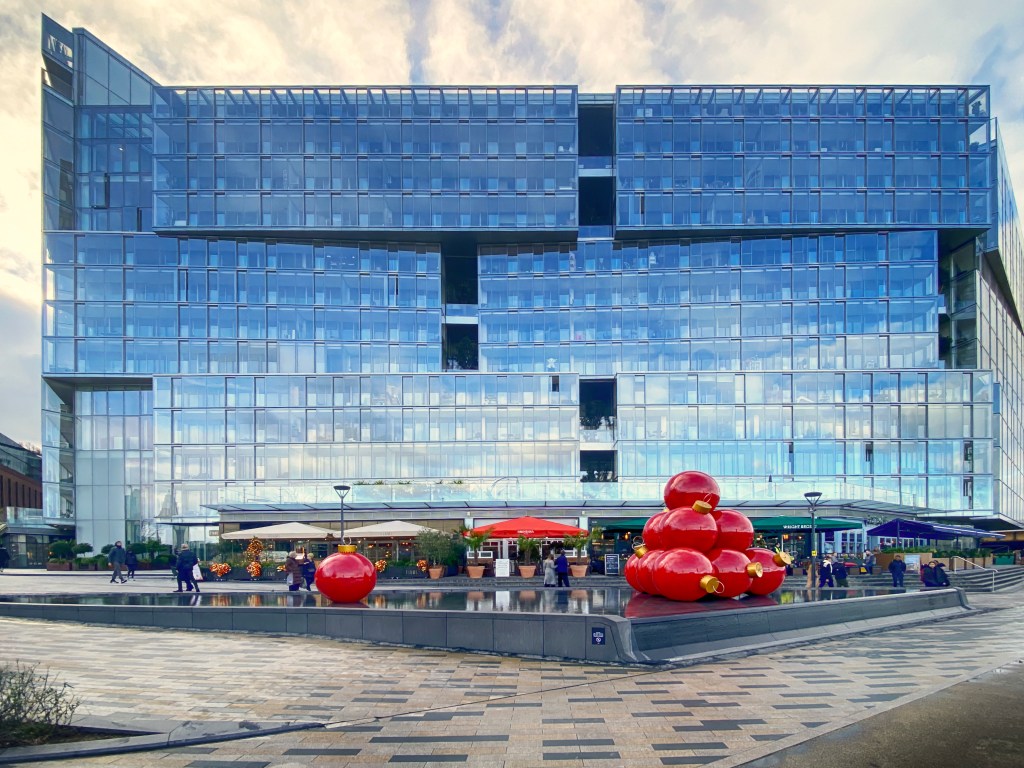
People wander along the Thames under this cool light—dog walkers leaning into the breeze, cyclists gliding past with focused ease, families pausing at railings to watch the river shift from silver to pewter. Even the new glass buildings seem gentler in the winter sun, trading sharp reflections for a soft, diffused glow. The market stalls arranged beneath the Power Station’s shadow look almost handcrafted by daylight—ceramics, woollens, pastries, all revealed in honest tones untouched by the dramatic glamour of evening. Here, winter’s beauty is tangible rather than theatrical, found in textures and movement rather than illumination.
Few places hold the holiday season as naturally as Covent Garden. Its cobblestones, arcades, and market halls seem as though London built them specifically for December.
Inside the grand halls, enormous red baubles hover like festive planets suspended in mid-orbit. Oversized mistletoe shines from iron rafters, catching the warm radiance of market lights below.

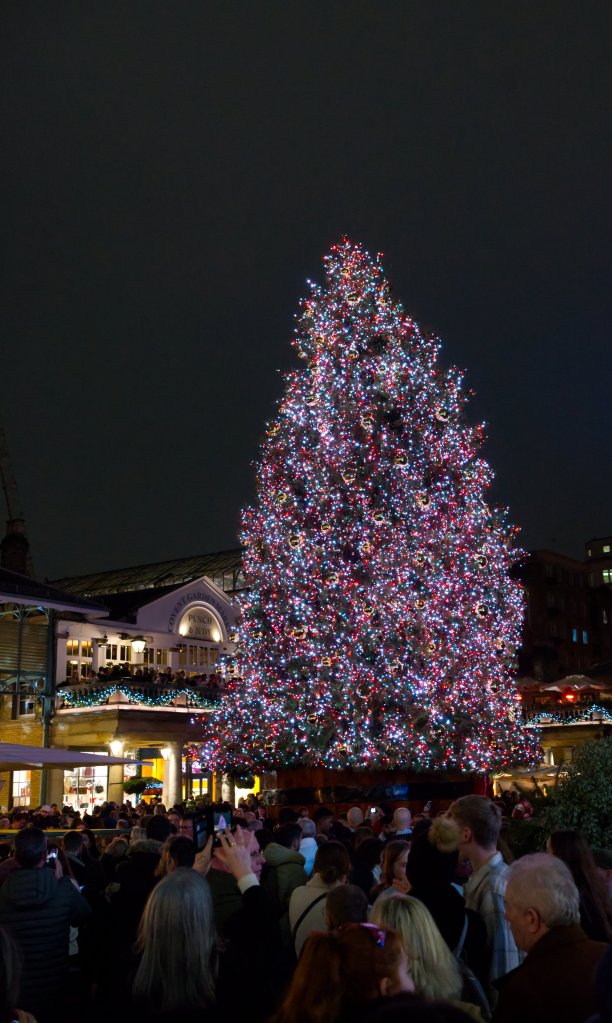
The district’s giant Christmas tree, iconic and evergreen, stands in its traditional place outside—towering, ribboned, and beautifully over-ornamented in the way that only Covent Garden can make timeless.
Music curls through the piazza. Street performers gather small crowds, their songs rising toward the rafters. The scent of roasted nuts and mulled wine drifts between the arches while shoppers weave through stalls draped in lights like strands of fireflies.
Covent Garden does not simply decorate for the season. It becomes the season. Every display—every wreath, every lantern, every garland—feels intentional, theatrical, and steeped in a kind of old-world charm that has never quite left the place.

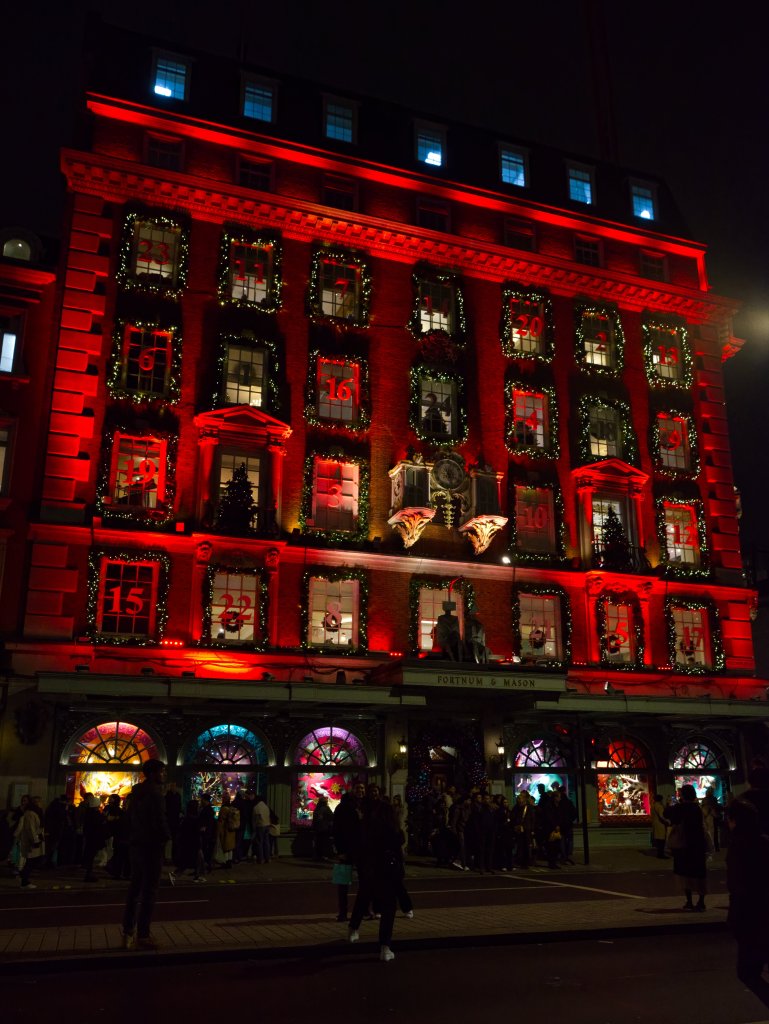
Fortnum & Mason stands as one of London’s most enduring tributes to holiday splendour. Year after year, the Piccadilly landmark transforms itself into something halfway between a kingdom and a confection—its façade glowing in warm, dignified tones, every window a jeweled vignette of seasonal wonder.
The building itself becomes a spectacle: deep reds, polished golds, and the elegant symmetry of Georgian architecture wrapped in garlands that seem almost imperial in scale. Clock towers chime above the glow. Lanterns flicker. Ribbons curl over the doorways. The entire exterior hums with a restrained opulence, a reminder that Christmas in London can still feel grand.
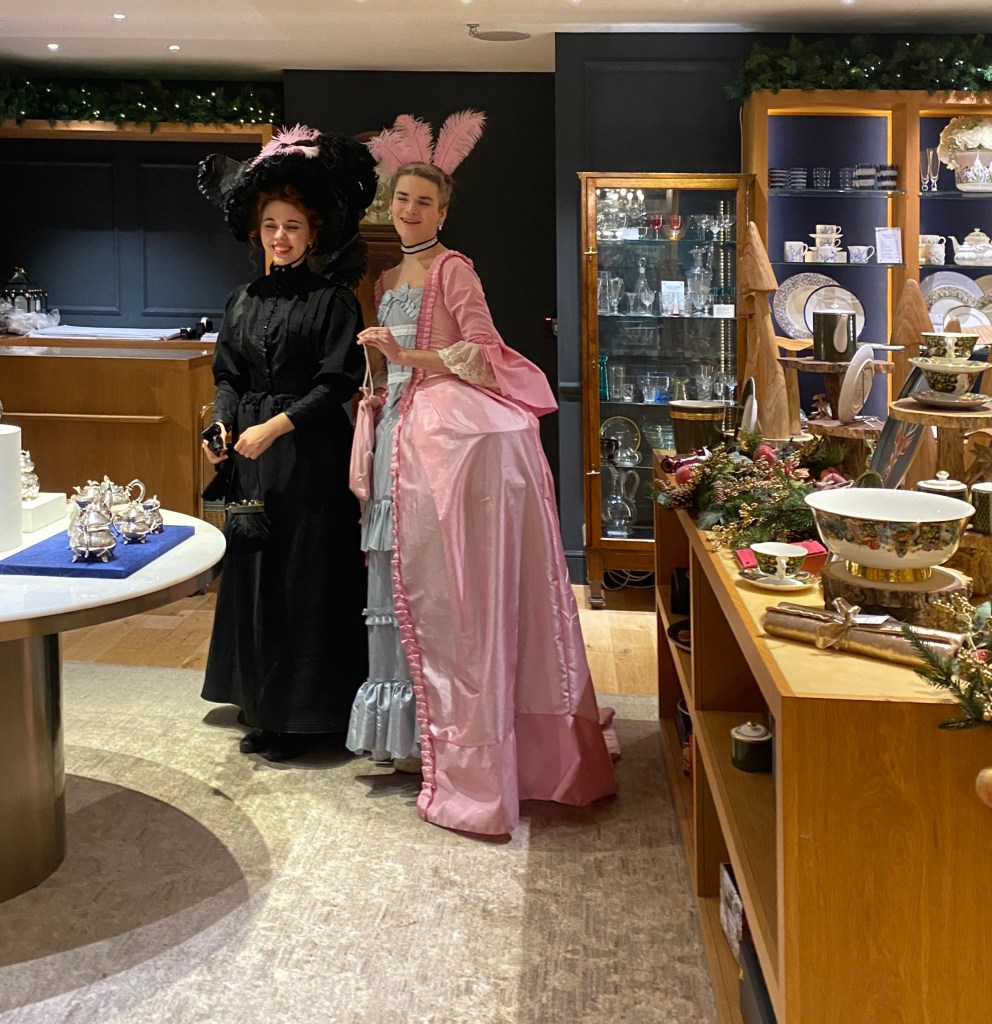
Inside, the story continues. Hampers rise in towers. Teas, preserves, confections, and ornaments form miniature landscapes of abundance, all arranged with the precision of an artist’s touch. The seasonal displays are crafted not just to attract the eye but to evoke nostalgia—an echo of carol halls, handwritten notes, winter feasts, and traditions passed through generations. Amid the gentle murmur of shoppers, two ladies dressed in Victorian attire drift between the aisles as though they’ve stepped out of a bygone winter card.
And in a season when London’s great emporiums seem to dress themselves with as much intention as the people who enter them, Harrods rises into view like a gilded landmark of winter tradition. Its terracotta façade, intricate even in daylight, carries an almost ceremonial grandeur in December.
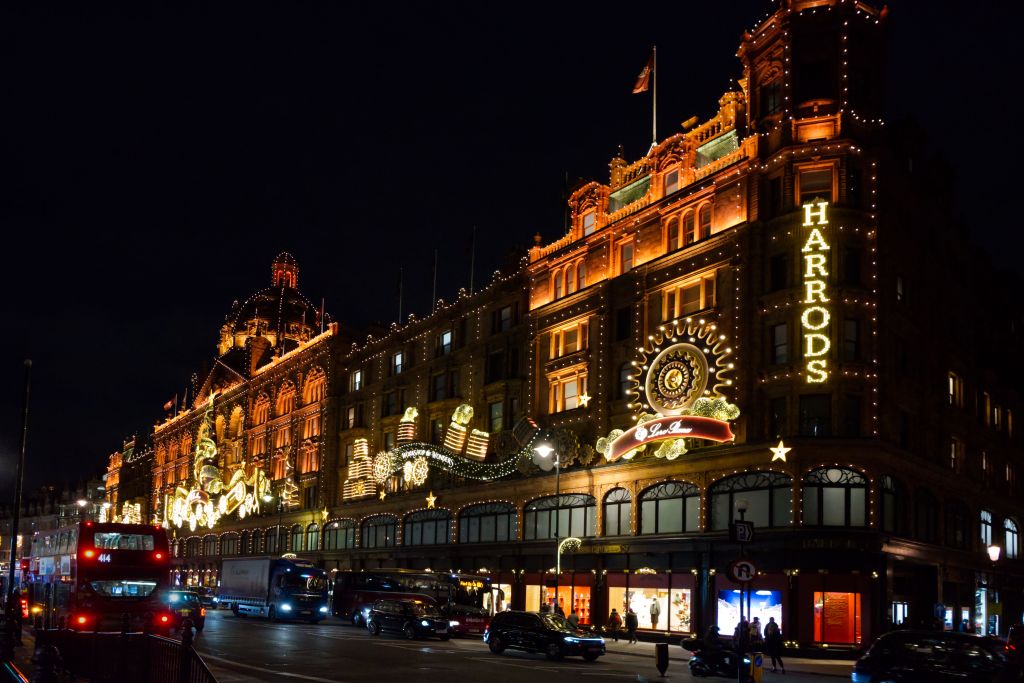
Bulbs—thousands of them—trace every arch, every column, every ornamental detail until the entire exterior seems gilded in warm gold. The windows act as polished mirrors for the glow, reflecting constellations of light onto the pavement where shoppers pause to take it in. Above, the rooftop line glimmers like a crown, modest in shape but extravagant in radiance. Harrods does not shout its presence; it simply rises, brilliant and steady, a winter beacon reminding London that even the architecture has joined the celebration.

In Knightsbridge, one of the grand hotels rises like a lantern against the night, its façade washed in warm light that spills across the pavement in soft, golden pools. Every window glows evenly, giving the building a quiet stateliness, as if it’s keeping watch over the wintry evening.

Just beyond its entrance, a nearby street stretches out in a ribbon of festivity, arched overhead with strands of Christmas lights that shimmer like suspended constellations. The bulbs shift gently in the breeze, scattering reflections across car roofs and the glossy shopfronts below. It’s a simple scene—light against darkness, architecture against sky—but in Knightsbridge, it becomes something quietly cinematic, a winter moment caught between elegance and calm.

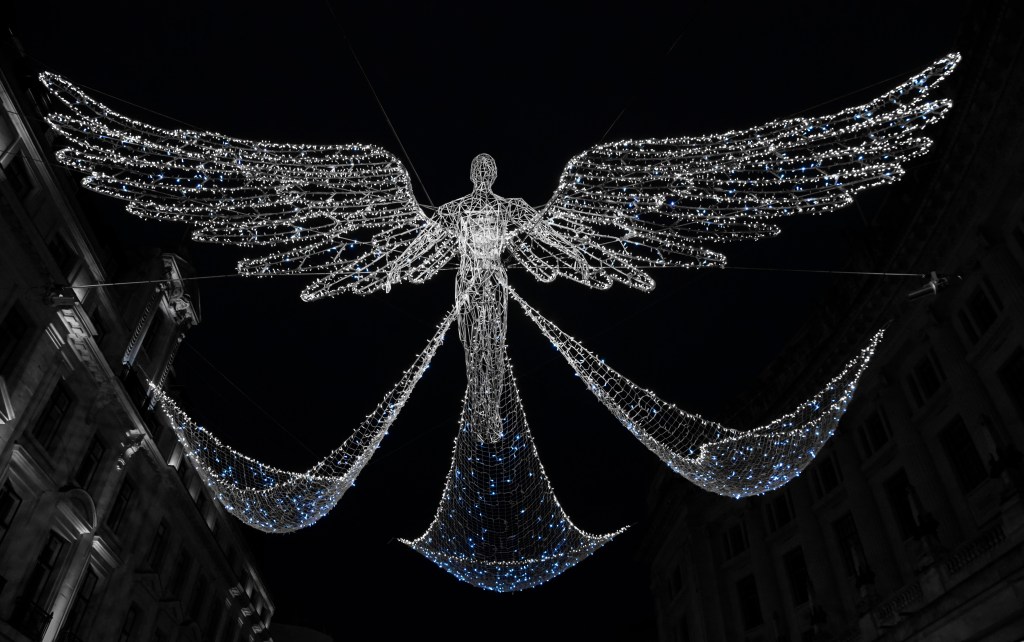
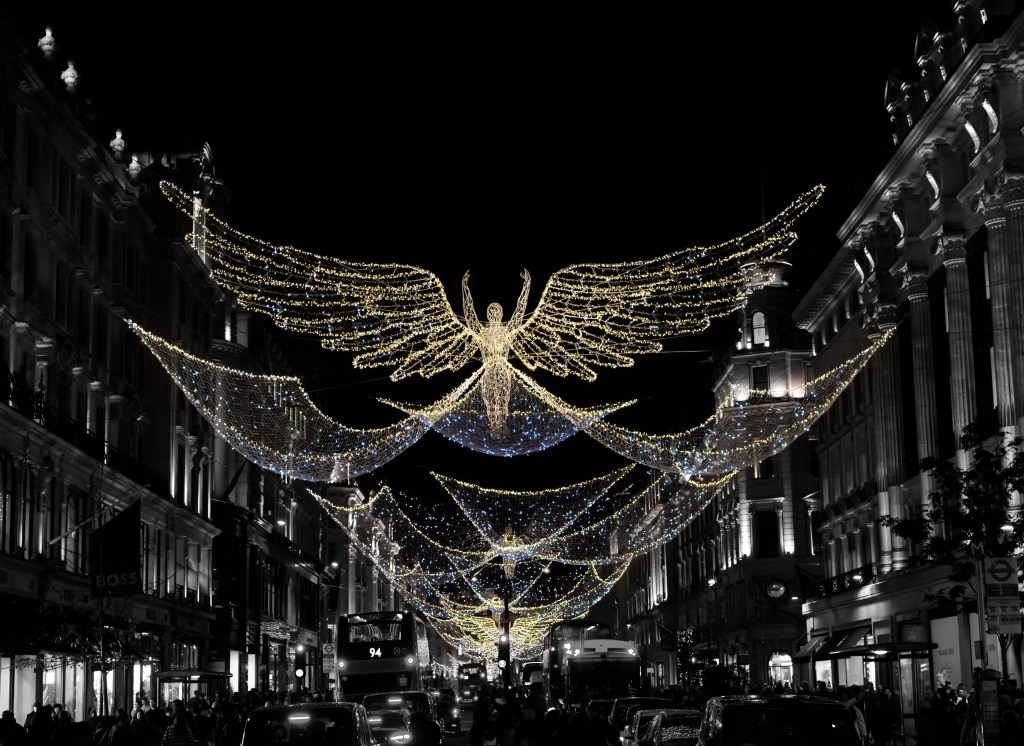
And of course there are angels—there are always the angels—sweeping above Regent Street as though the entire curve of the boulevard were designed for their wings alone. At night they become fully alive, each one radiant with thousands of tiny lights that shimmer in a slow, breathing glow. There’s something reverent about Regent Street’s display. People slow down here. The angels aren’t loud. They don’t need to be. Their power is in the hush they create, the sudden awareness of sky, breath, time.
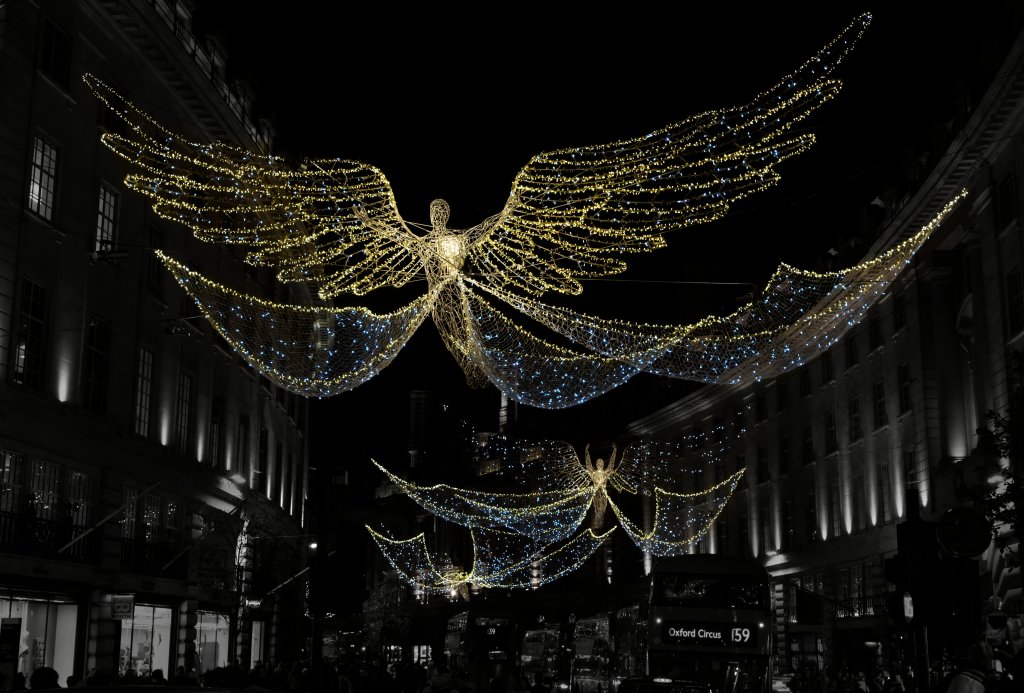
These angels are more than decorations; they are emblems of ceremony. They arrive each year like guardians of the season, timeless and serene. And Regent Street, with its stately architecture and inherent grandeur, welcomes them as though they have always belonged here. Their wings stretch wide across the roadway, feathered in cascades of brilliance that ripple gently with the winter air. Below them, the grand façades echo the light in soft reflections, turning the whole street into a river of gold and silver movement. Cars drift beneath the celestial canopy like quiet shadows, while pedestrians pause mid-stride, faces lifted, caught for a moment between the earthly bustle and the luminous guardians overhead.
Regent Street feels almost otherworldly under their watch, as if the angels have descended not to dazzle, but to remind the city of its own enduring sense of wonder. The effect is both monumental and intimate: a street that becomes a sanctuary, a city that becomes a cathedral of winter.
As the golden strands of light ripple across the façades, the shopfronts below awaken, revealing miniature worlds tucked behind glass. In some, squirrels take center stage—small, clever characters frozen in mid-celebration, each one caught in a pose that tells the story of the Christmas year.
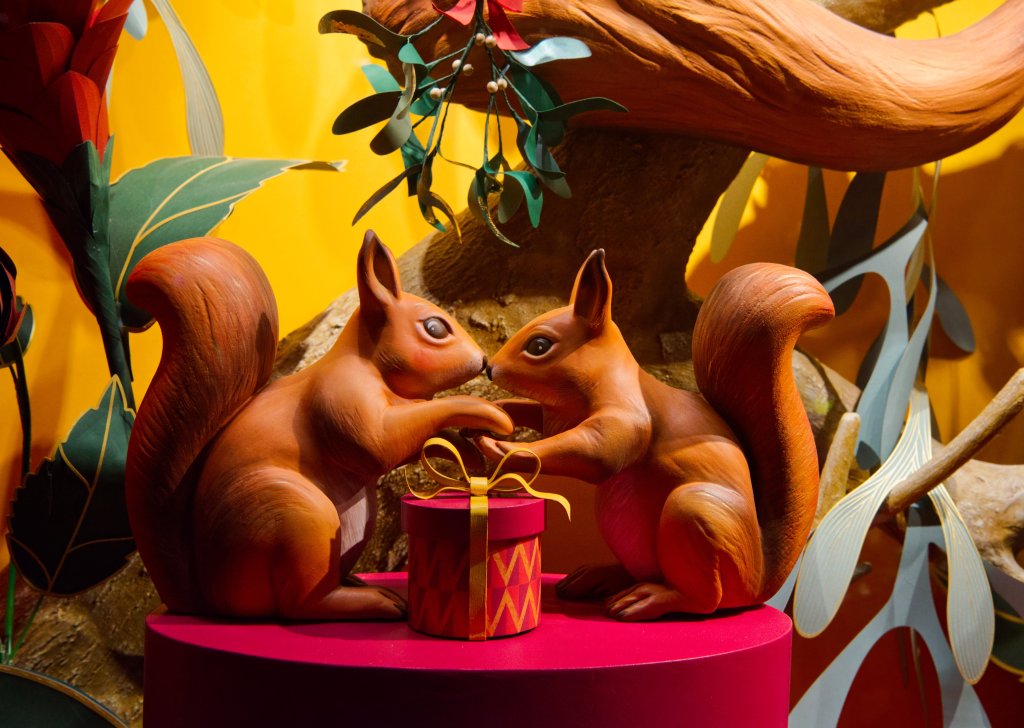
Each storefront seems to have its own cast, a small community of whiskered figures who dance, toast, and gesture with playful precision, turning the simple act of passing a window into a moment of enchantment.

Children press their noses to the glass, captivated by the movement and detail, while adults pause, caught between amusement and nostalgia, reminded that even the tiniest creatures can carry the spirit of Christmas through the streets of London.
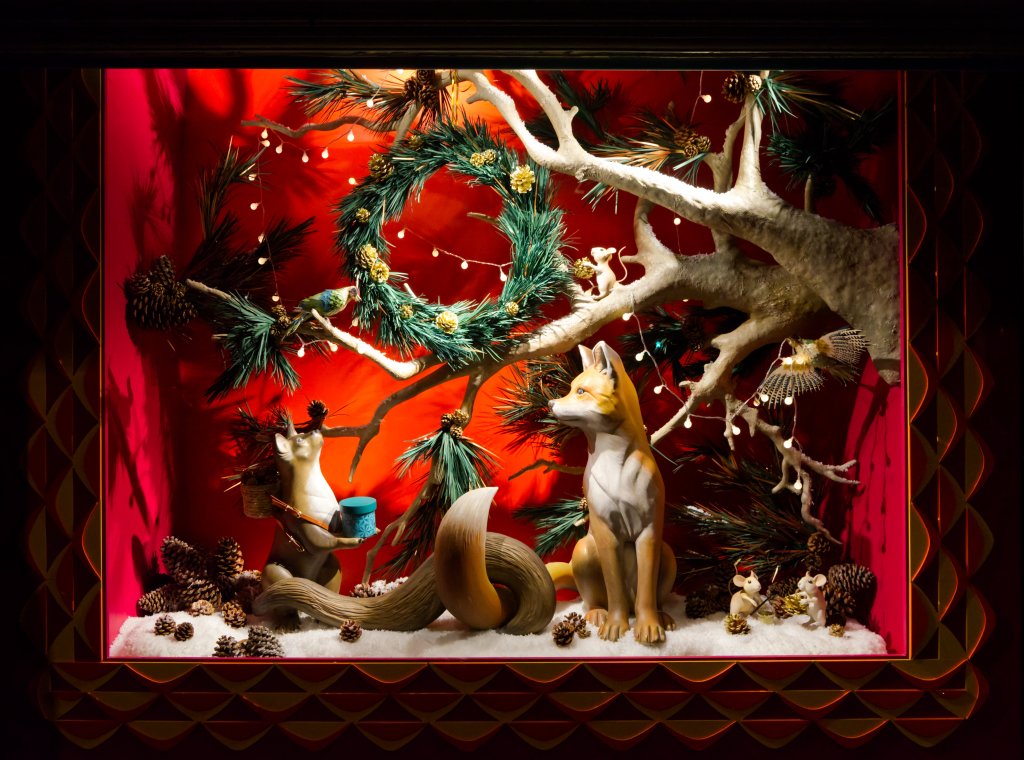
London’s storefronts love to flirt with the mythic, filling each glass pane with creatures that could only exist in imagination. Their scales and feathers glint under spotlights, metallics catching the eye with every subtle movement of mechanical joints. Pedestrians linger, caught between awe and disbelief, caught in the quiet thrill of seeing legends made tangible. These displays suggest a city where magic still walks openly in daylight and winter, a gentle reminder that wonder thrives in the spaces between the familiar and the fantastical.

Some storefronts keep their stories simple, yet no less enchanting. Behind the glass, evergreen trees rise in miniature forests, their branches dusted with glittering snow and twinkling lights. Beneath them, presents are stacked like jewels—ribbons curled perfectly, boxes gleaming with gold, silver, and crimson. The effect is quiet but captivating: a celebration of winter abundance distilled into a single, perfect scene.

Taken together—the glittering lights stretched across streets, the grand façades glowing in gold and warmth, and the intricate storefronts alive with miniature worlds—London becomes a city transformed, each district offering a new scene, a fresh story, a fleeting moment of wonder. It is a spectacle that cannot be captured in photographs alone; it must be walked through, felt underfoot, breathed in between steps, savored in the pause before a window or beneath a canopy of light. And because no two years are quite the same, the city offers a new adventure each December, a reminder that in London, winter is not merely a season, but a journey woven in light, imagination, and the quiet thrill of discovery.

 The Footstep Chronicles
Leave a comment