

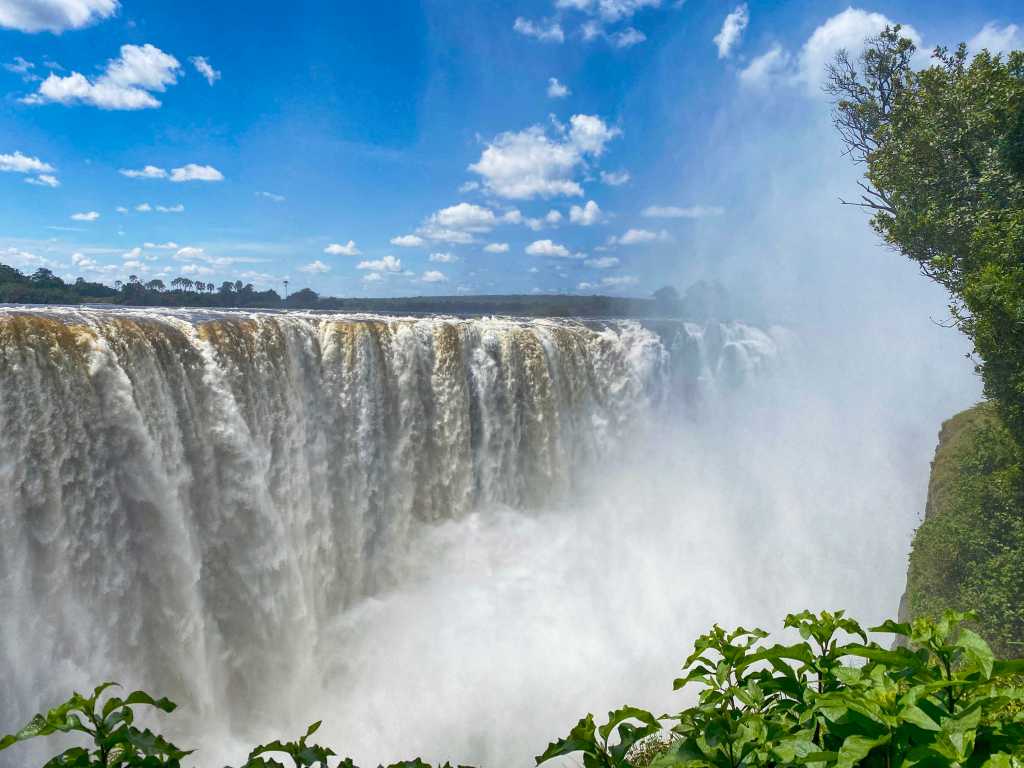
The river doesn’t fall—it disappears. One moment, the Zambezi flows broad and smooth; the next, it vanishes into a crack in the earth, dropping with such force that the ground seems to tremble. The local name is Mosi-oa-Tunya — “The Smoke That Thunders” — and nothing captures it better. You see the mist before the water. You hear it before you arrive.

Victoria Falls straddles the border between Zambia and Zimbabwe, a geological rupture where the Zambezi River plunges over a 1.7-kilometer-wide cliff, dropping more than 100 meters into the gorge below. It’s not the tallest waterfall, nor the widest, but it is among the largest in sheer volume and scale. At peak flood, more than 500 million liters of water thunder over the edge every minute, throwing up clouds of spray that can be seen over 40 kilometers away.

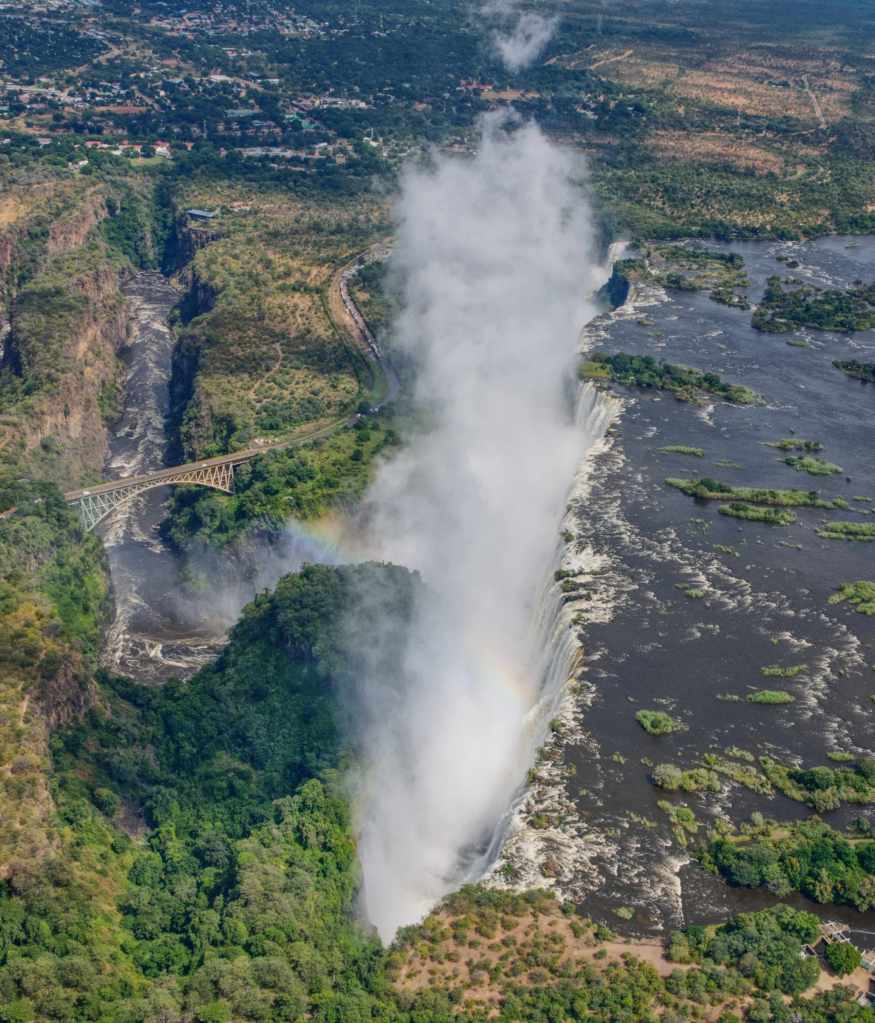
From above, Victoria Falls appears as a vast, living scar cut into the earth — a ribbon of churning water that suddenly plunges into a narrow, jagged gorge. The Zambezi River upstream is dotted with small islands and braided channels, before it breaks at the edge in a sheer, unbroken curtain. From this height, the constant spray rises like drifting smoke, forming rainbows that arc over the chasm. Beyond the falls, the river twists sharply through zigzagging gorges carved over millennia, a reminder of the relentless force that shaped this landscape.
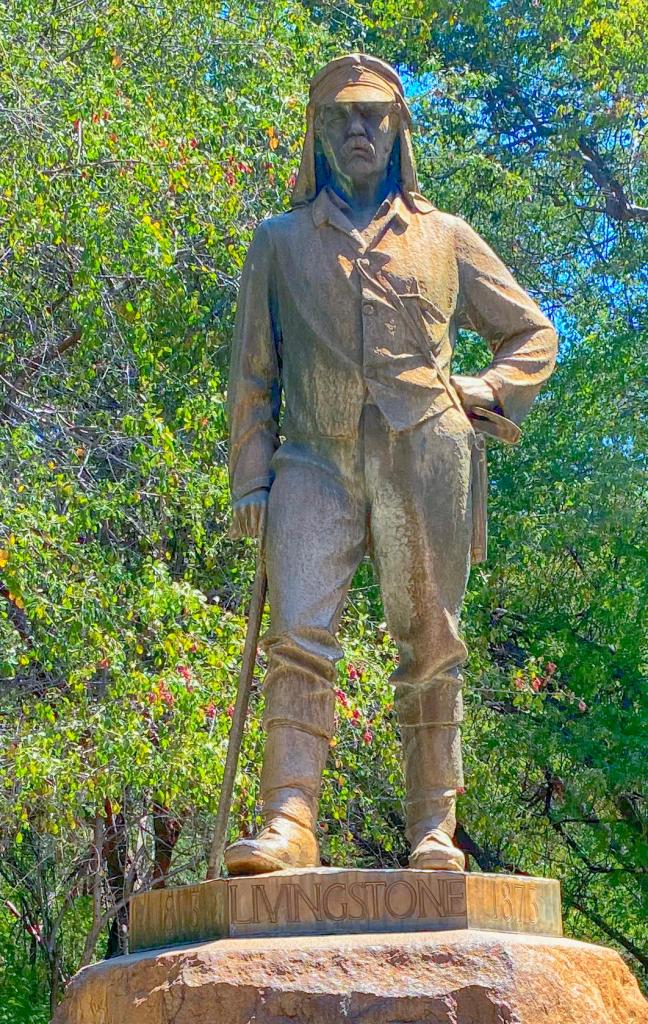
British explorer David Livingstone is credited with the first European sighting in 1855, naming the waterfall after Queen Victoria. But the place had a name long before that, and a history that predates colonial maps. The falls were known for centuries by the Indigenous Tonga people who lived along the Zambezi. They spoke of a sacred site — a place where ancestors could be heard in the roar and seen in the rising mist. They have long believed the falls are home to ancestral spirits. According to oral traditions, the river is watched over by the Nyami Nyami, the Zambezi River God — often depicted as a serpent or dragon with the body of a snake and the head of a fish. The Nyami Nyami is said to protect the valley’s people, but also to punish those who disrupt its balance.
The surrounding rainforest exists because of the mist. It is one of the few places on Earth where you can walk through a rainforest fed entirely by waterfall spray. Moisture clings to every leaf and rock. Ferns thrive in the perpetual drizzle. Birds weave through the vapor. And if you arrive at the right time of day, you may catch a rainbow arcing across the entire gorge—so bright it looks like it was painted there.
In the dry season, the falls become fractured—separate streams trickle down the face of the basalt cliffs, revealing dark stone behind the water. The air is still heavy, but quieter. In contrast, the wet season brings fury: the roar becomes deafening, and the mist hangs so thick you can’t see your hand in front of you. Photographs vanish into vapor.
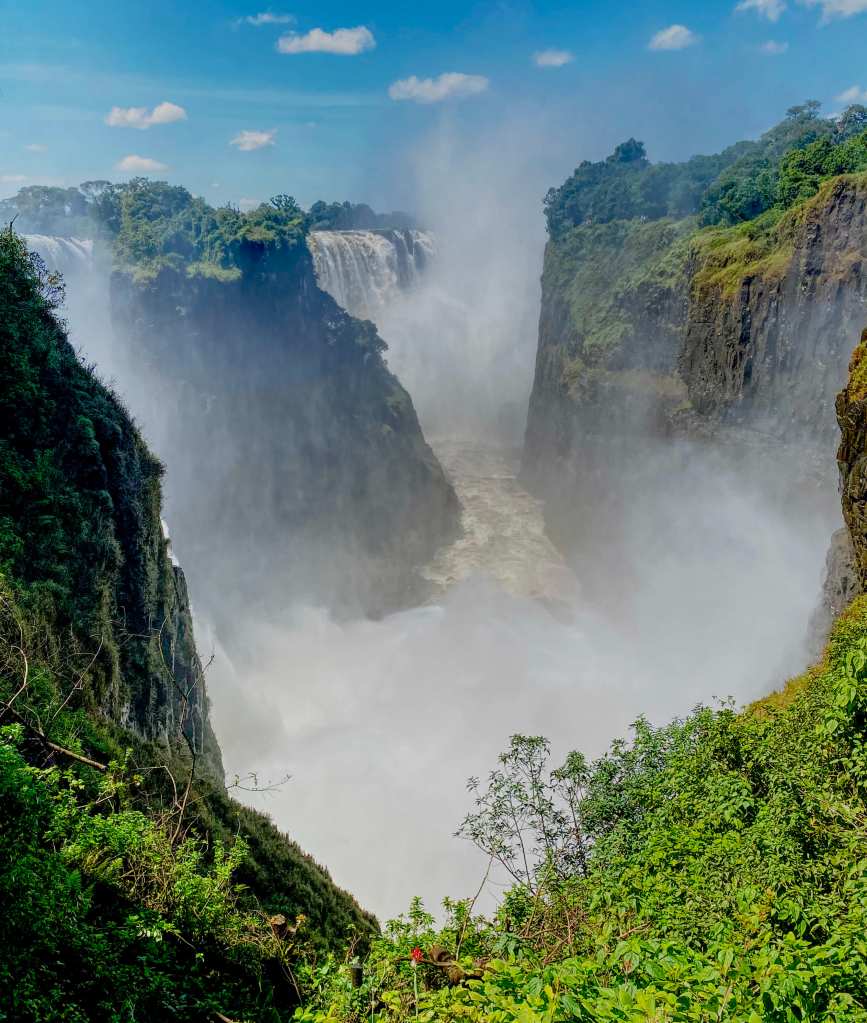
The Victoria Falls Bridge, constructed in 1905, stands just downstream. Originally part of Cecil Rhodes’s grand plan for a railway from Cape Town to Cairo, it now hosts bungee jumpers and border crossings. Trains still pass, but slowly. Like most things here, time seems to stretch — held in place by water, stone, and air.
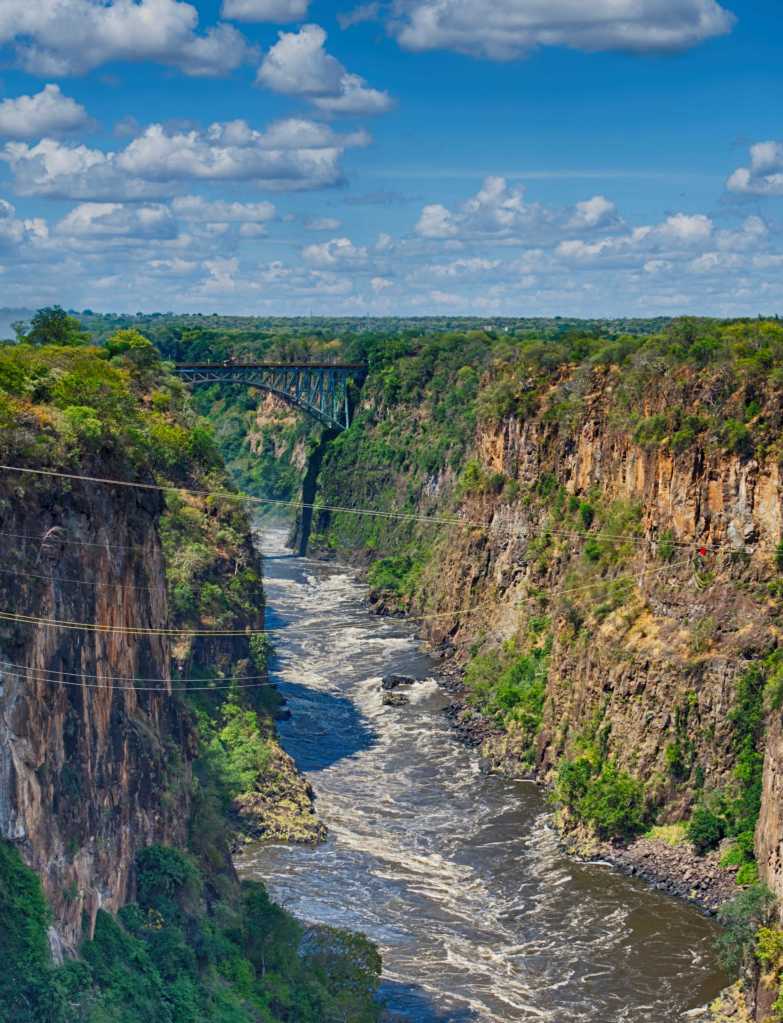
There’s a viewpoint just before the final curve of the gorge. If you wait there long enough and and the mist clears for a moment. The full width of the falls comes into view — impossible in scale, fleeting in detail. To stand at the edge of the falls is to watch the continent breathe. It’s not just a waterfall — it’s a pulse in the land.
You don’t need to speak. The falls speaks for you.
 The Footstep Chronicles
Leave a comment