

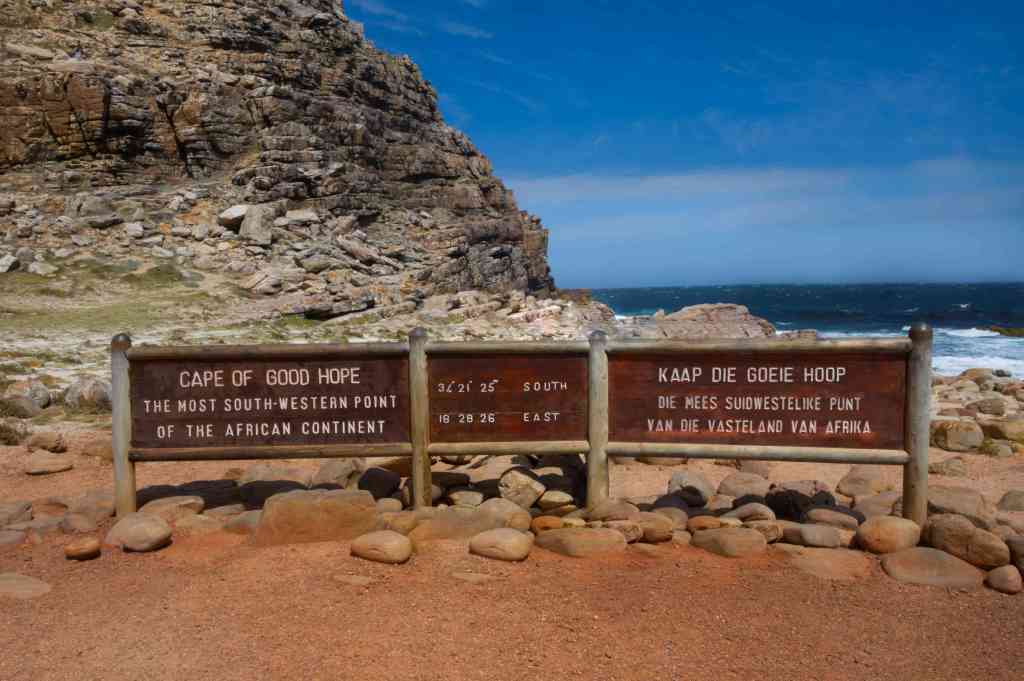
At the southern edge of the African continent, where mountains drop into the sea and winds whip the air into restless motion, lies Cape Point. Travelers speak of it in half-mythical terms: the place where two oceans meet, where land runs out, where the world feels both vast and intimate all at once. The journey there is not just about geography—it is about standing at a place where nature stages its grandest performance, and you are invited to bear witness.
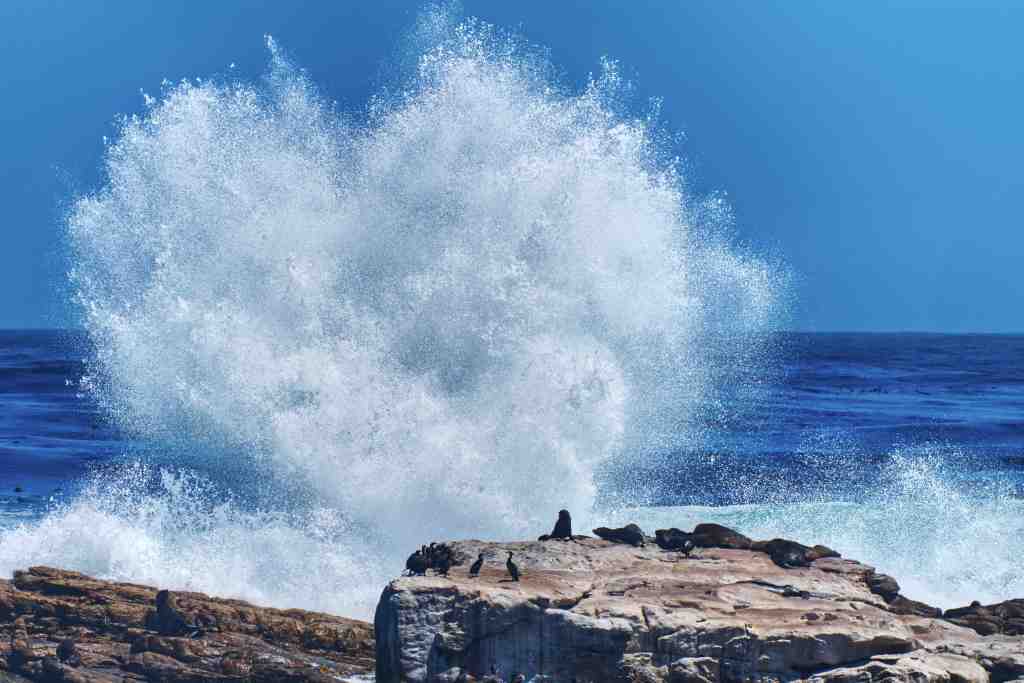
From the moment the cliffs first rise into view, Cape Point declares itself as something elemental. Sheer rock faces plunge into the sea, the surf exploding in white fury. Overhead, seabirds ride the air as if the winds were crafted for them alone. Even before you glimpse the lighthouse, before the panorama of blue upon blue unfurls, you sense that Cape Point is a threshold—a meeting place of waters, of histories, of lives that have brushed against its rugged edge.
The road that winds toward Cape Point traces past some of the Cape Peninsula’s most breathtaking beaches. Vast white sands stretch for kilometers, their brightness almost blinding under the African sun. These are not secret bays tucked under cliffs, but great sweeps of shoreline open to sky and sea, where the horizon feels impossibly far away.


On summer days, paragliders rise like bright specks above the dunes, catching the thermals and drifting over the coastline. Parasailors skim across the surf, their kites snapping in the wind, the sea foaming beneath them. Fishermen cast lines at dawn, their silhouettes sharp against the rising light. And along the sand, families wander, their laughter carried by the breeze, footprints trailing behind them until the tide claims them back.
These beaches are places of energy and motion, in contrast to the solitude of Cape Point’s cliffs. Here, the sea is still wild, but it is also playful, inviting people to test themselves against its wind and waves. The journey to Cape Point is punctuated by these shores, a reminder that the road to the continent’s edge is as alive as the destination itself.

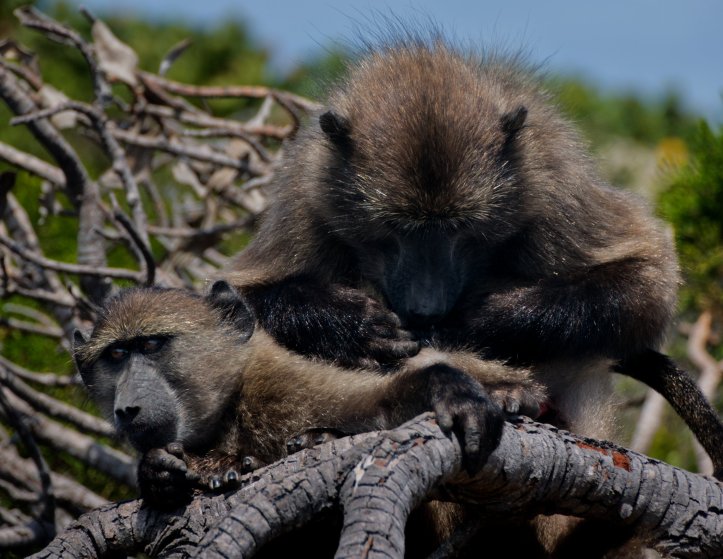
No account of Cape Point is complete without mention of its most notorious residents: the chacma baboons. They roam the reserve in troops, their movements as much a part of the landscape as the seabirds overhead. Watching them is to glimpse the wildness of the Cape embodied in fur and muscle, intelligence sparking in their dark eyes.
They are clever, curious, and, at times, unashamedly mischievous. Tourists who forget to lock their car doors or secure their backpacks soon learn that baboons know how to open zippers, rummage through coolers, and snatch sandwiches from distracted hands. On the roadsides and sometimes even near the lighthouse, they appear suddenly, a troop crossing the tarmac with the calm authority of creatures who know the land is theirs as much as anyone’s. They are reminders that Cape Point is not only about scenery—it is also about the wild pulse of life that still beats strongly here.


The old lighthouse, perched high on the promontory, is Cape Point’s crown. Built in 1859, it once guided ships along this treacherous coast, though it proved too high—its light often swallowed by mist while storms raged unseen below. Today it stands as a monument, its white walls and red roof stark against the sky.
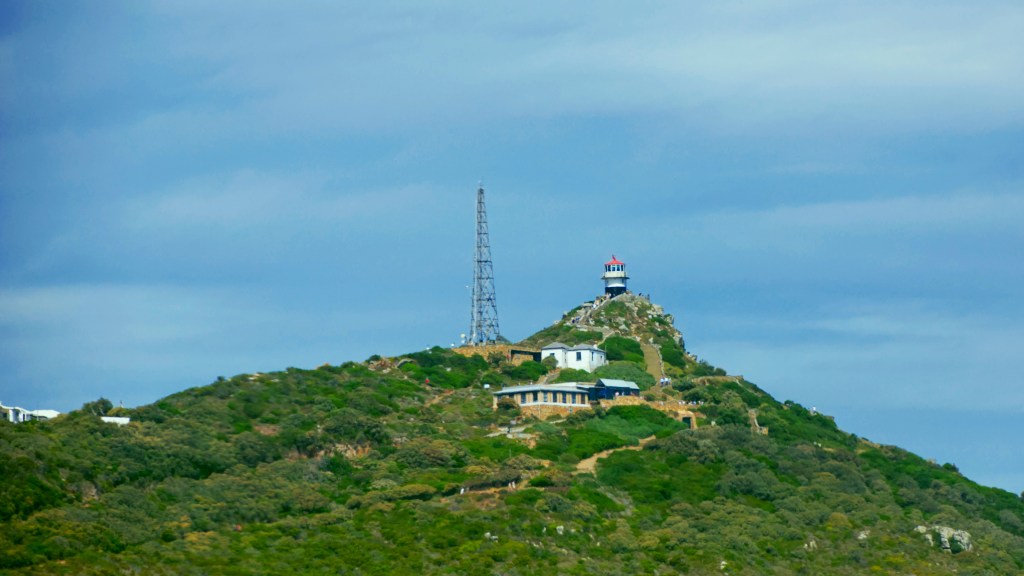
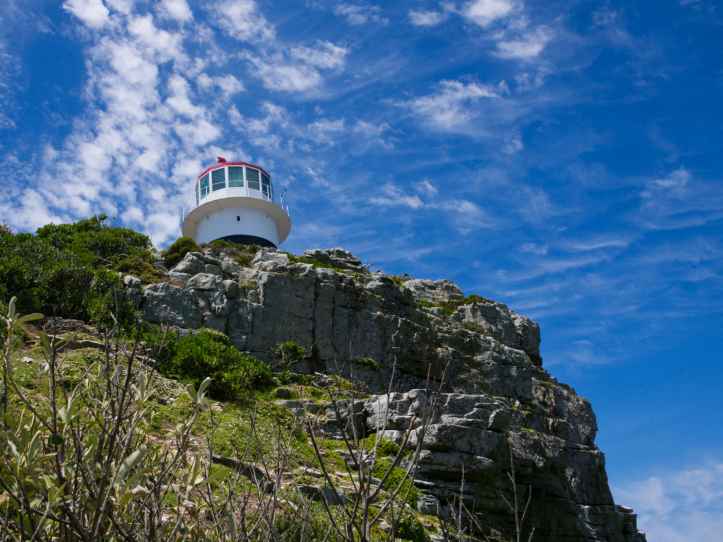
The climb up is steep but rewarding. A funicular, the Flying Dutchman, carries visitors partway, but many choose to walk, winding along paths lined with fynbos—South Africa’s unique floral kingdom. The air is laced with salt and wild herbs, and the wind grows stronger with every step. By the time you reach the top, it feels as though you are standing at the edge of the world.
From the viewing platform, the panorama is staggering. To the west lies the Atlantic, deep and restless, stretching toward the Americas. To the east lies False Bay, its waters calmer, touched by the warmer currents of the Indian Ocean. Between them, the Cape Peninsula thrusts like a great arm into the sea, defiant and unyielding.
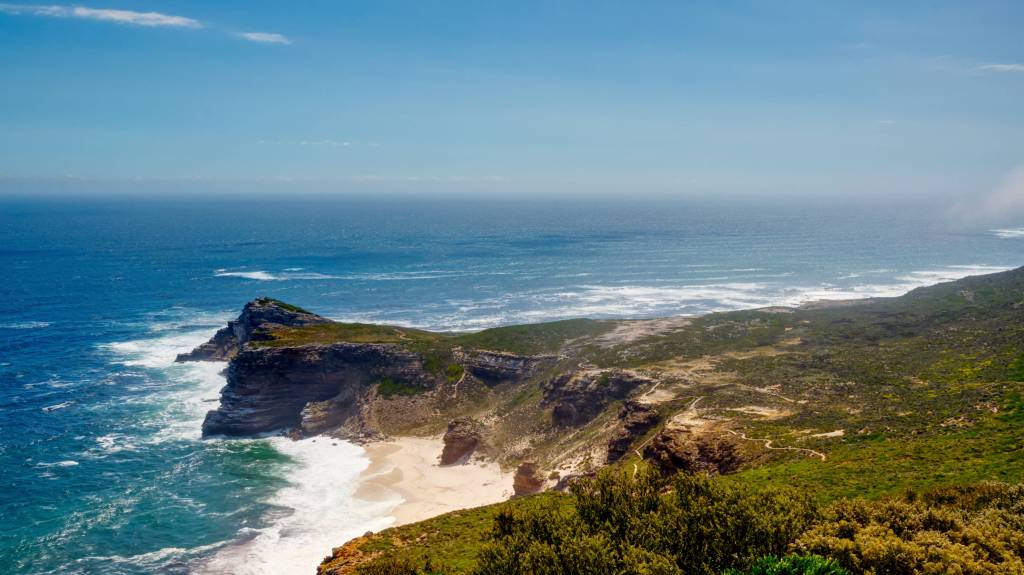

Cape Point has long been romanticized as the meeting place of the Atlantic and Indian Oceans. In truth, the precise line of division shifts farther south, near Cape Agulhas, the continent’s actual southernmost tip. But here, at Cape Point, the illusion feels truer than any scientific demarcation. You can look to your left and see one sea, look to your right and see another, and in the crashing waves below, you hear the dialogue of oceans in conversation.
The currents are indeed different: the cold Benguela sweeping north along the Atlantic side, and the warmer Agulhas pushing south from the Indian Ocean. This mixing of waters creates a richness of life, from great shoals of fish to whales and dolphins that sometimes pass offshore. To sailors of centuries past, this was the Cape of Storms, feared for its tempests and reefs. To travelers today, it is awe distilled into a single horizon.
Cape Point carries not only natural grandeur but human history. Long before Portuguese sails appeared, the Khoisan people lived along this coast, fishing its waters and moving with the seasons. Their presence is harder to see today, but their connection to the land endures.
In 1488 Bartolomeu Dias rounded the Cape, naming it the Cabo das Tormentas—the Cape of Storms—for the fury of its seas. It was later renamed the Cape of Good Hope, a name more hopeful than honest, promising passage to the East. Shipwrecks still litter the coast, reminders of the dangers faced by those who braved these waters. The legend of the Flying Dutchman, the ghost ship doomed to sail forever, is said to haunt this coast—a tale born of sailors’ fear of the storms.

Trails lace across the reserve, offering travelers a chance to feel the Point with their own steps. The Cape of Good Hope trail winds along cliffs and through stretches of fynbos, the plant life unique and resilient. In spring, the slopes burst into color—proteas in bloom, ericas glowing pink, daisies splashing the ground with yellow. To venture through the park is to explore the point that is untouched except for its winding pathways.

The walk to the tip of Cape Point feels both daring and grounding. Eventually the path delivers you not to a summit, but to the shore itself—strewn with boulders and rounded stones polished by centuries of surf. Here the sea comes in hard, curling white around the rocks, pulling back in long, hissing sighs before rushing forward again. Each wave feels like the ocean testing the land, pressing and withdrawing, pressing again.
Standing there, with the cliffs rising in the background, you feel the rawness of the place. The air is thick with salt, the rocks slick beneath your boots, and the water endlessly in motion at your feet. Gulls wheel overhead, their cries sharp against the wind, while sprays of foam burst into the air like breath from the sea itself.
To stand on this rocky shore is to stand at the edge of something far greater than yourself. Behind you, the continent rises in layers of stone; before you, the Atlantic and Indian waters meet in restless conversation. It is not just a view—it is an immersion, a reminder that the edge of Africa is not a line on a map but a living boundary, written in rock and tide.

Cape Point is a place where stories overlap. The sailors who rounded it centuries ago left behind tales of storms, ghost ships, and impossible seas. For them it was fear and promise entwined, a threshold between continents. For us, it is no less a threshold—though instead of peril, we find wonder. We stand where they once sailed, but with the luxury of stillness, of gazing at the same headlands without the terror of wreck or storm.
Yet the sea reminds us that not much has changed. The waves still batter the rocks with unrelenting force. The winds still roar through the gullies. The ghosts of wrecks still lie beneath the water, claimed by the same currents that once made the Cape famous. What has changed is only our role: we are no longer passing in fragile wooden hulls, but standing on the shore, humbled, remembering.
For every visitor who pauses here—whether watching the spray burst over the boulders, or listening to the baboons bark on the hillside, or tracing the flight of a gull across the wind—the experience is part of a continuum. Cape Point is not just landscape. It is a meeting of elements, of histories, of human longing for the edge of the known.
And so it becomes a place of return, in memory if not in footsteps. To leave Cape Point is to carry it with you: the roar of two oceans in your chest, the salt on your skin, the image of the land tapering into sea like a prayer written in stone. It endures because it reminds us of what we often forget—that the world is vast, untamed, and astonishing, and that we, for all our maps and machines, are still travelers at its mercy.

 The Footstep Chronicles
Leave a comment