
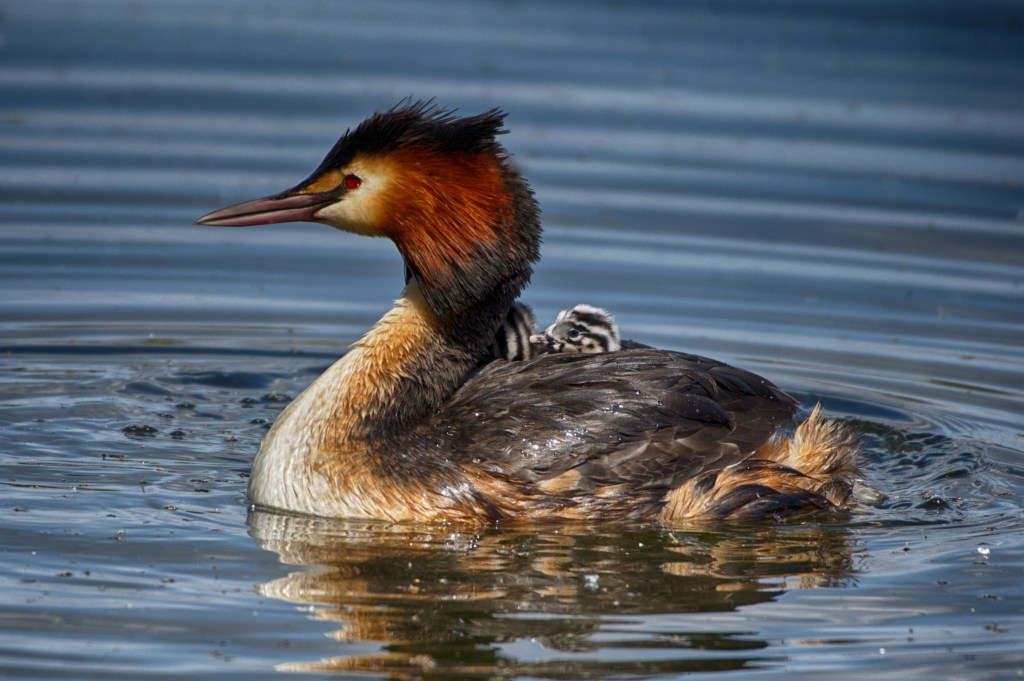
There are birds that pass overhead like punctuation marks in the sky, brief and forgettable. And then there are birds that turn water into a stage. The great crested grebe (Podiceps cristatus) belongs firmly in the latter category, a creature of elegance and quiet drama whose habits feel almost like a performance. Around Lackford Lakes in Suffolk UK, these birds bring a kind of living theatre to still water, transforming ordinary mornings into something closer to a measured, unfolding spectacle.
The great crested grebe belongs to water in a way that feels absolute. At Lackford Lakes it reads like a dark calligraphy stroke drawn across the surface, neck upright, body low, drifting between reed shadows and open brightness. Its legs sit far back on the body, turning every movement into a kind of underwater propulsion. On land it is seldom seen, and when it is, the impression is of something borrowed from another world, briefly set down on grass before returning to its element.
Across the seasons its appearance shifts. In breeding months the head carries dark plumes and chestnut fringing that catches the light in sudden flashes. In winter this ornament softens, the bird becoming quieter in tone but no less precise in movement. Even then, it holds a posture that seems to belong entirely to water.
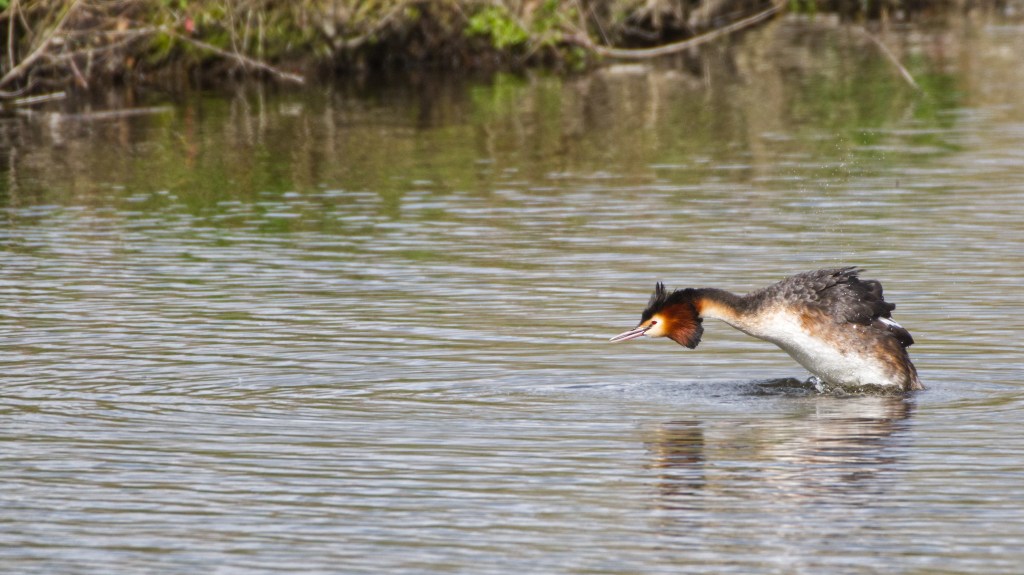
Lackford Lakes is not a single space but a layering of waters, channels, reed beds, and open pools. Within this living map, grebes choose margins where depth meets cover. They drift between reed edges and open stretches, appearing and disappearing with small dissolves beneath the surface. Each dive erases them briefly, leaving only a widening ring that fades before the eye can hold it. To watch them is to learn the lake in fragments. Not as a whole seen at once, but as a sequence of arrivals and vanishing points.
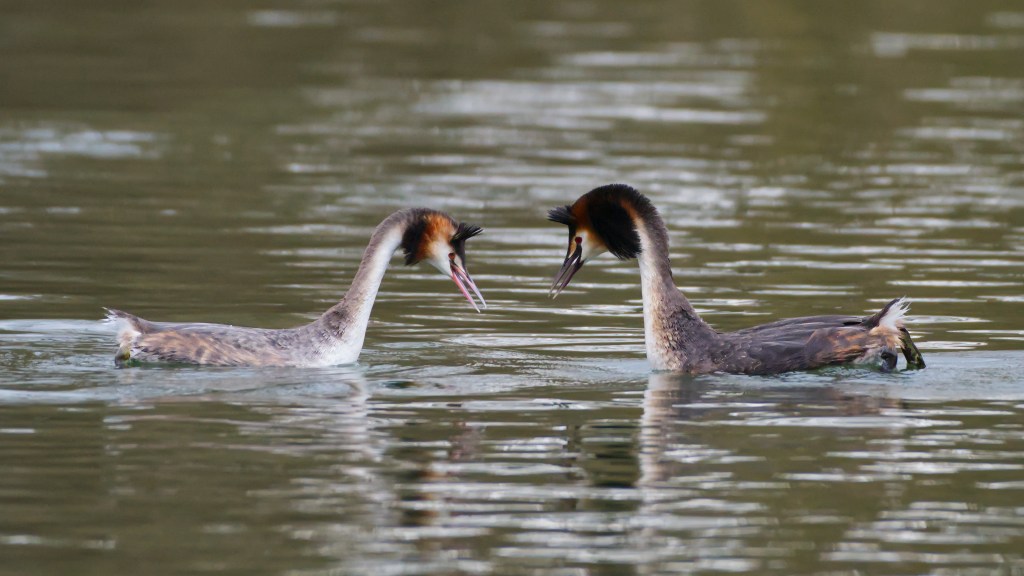
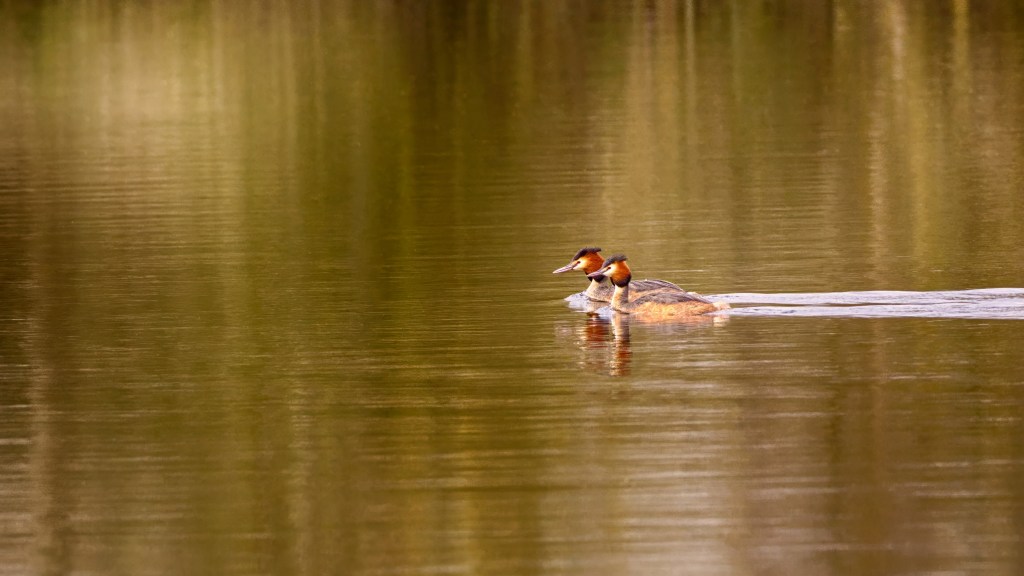
If you happen to be near one of the lakes in early spring, you might witness one of the most celebrated courtship displays in the bird world. The great crested grebe’s mating ritual is not just behavior; it is spectacle. Pairs face each other and rise in the water, bodies aligned, then settle back down. This sequence repeats. Between repetitions, weed is gathered from below and exchanged at the surface.
These actions are not decorative. They function as recognition. Each movement confirms the presence of the other in a shared space that is otherwise unstable and reflective. From the paths above, these moments can appear as brief interruptions in an otherwise continuous drift of waterbirds. From closer observation, they form a pattern that holds the pair together in repeated recognition.
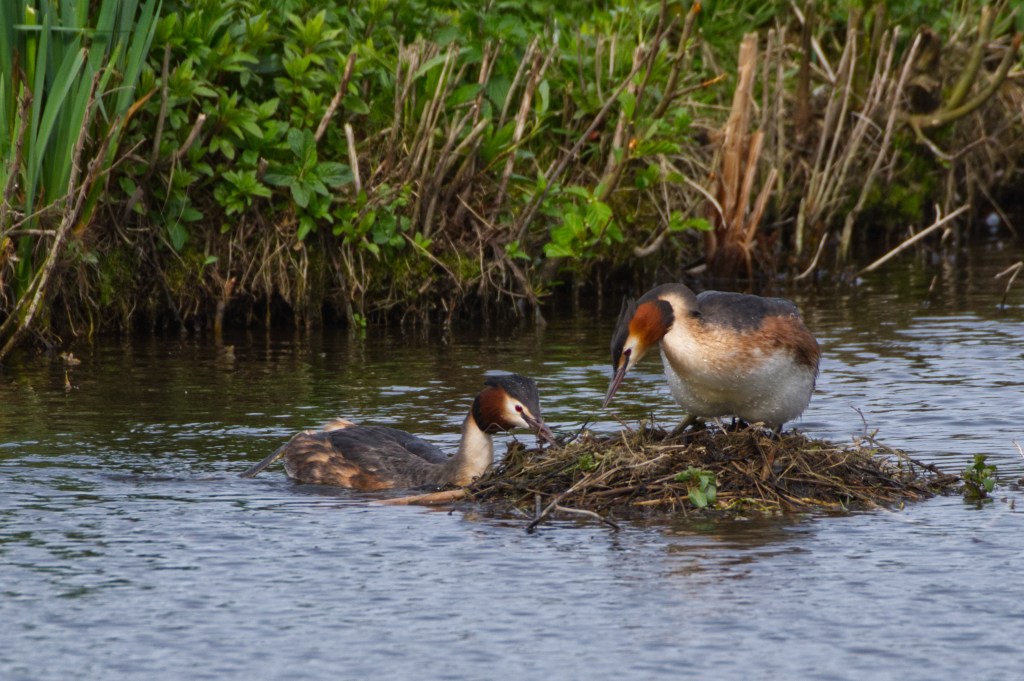
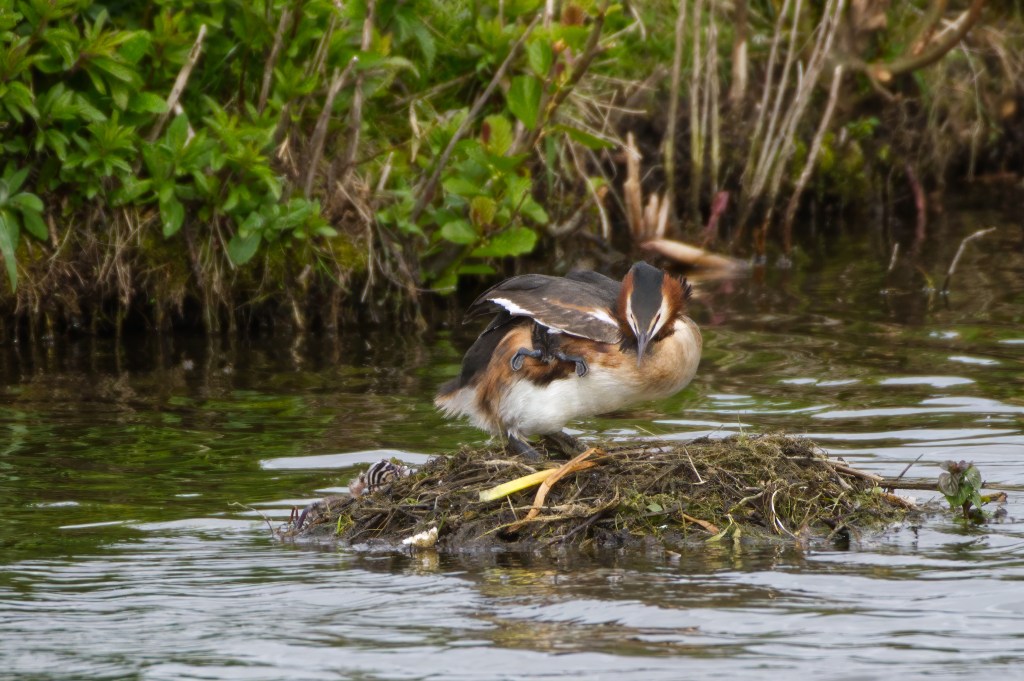
Once paired, grebes waste little time establishing a nest. Unlike many birds that retreat to trees or hedgerows, the great crested grebe builds directly on the water. The nest is a floating platform of decaying vegetation, anchored to reeds or submerged branches. This design is both practical and precarious. It rises and falls with the water level, adjusting naturally to changes in the lake. But it also means that the eggs are never entirely safe from disturbance, whether from waves, predators, or curious passersby.
At Lackford Lakes, where reed beds provide essential cover, these nests are often tucked just out of sight. If you do spot one, it may look like nothing more than a soggy heap of plant matter. Yet within that heap lies a carefully constructed nursery, warmed by the slow heat of decomposition as much as by the parent’s bod
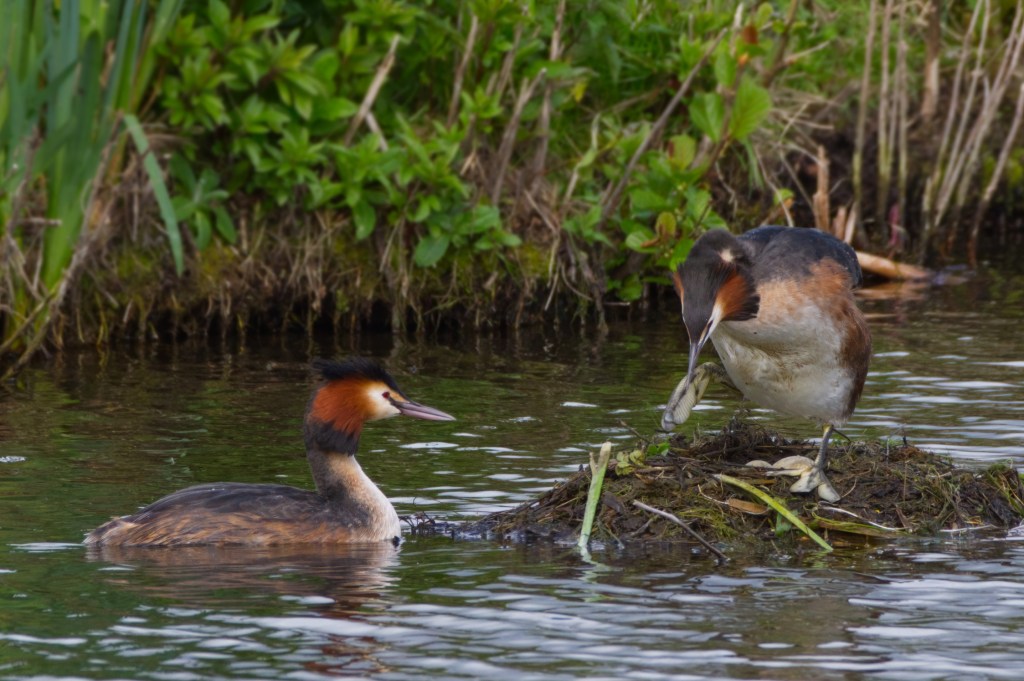
Both adults share incubation. The nest is rarely unattended for long. One bird remains while the other moves outward to feed, diving repeatedly and returning across short distances of open water. Changeover is a surface event. One presence replaces another without break in the continuity of care. The nest does not experience absence as absence. It experiences it as rotation. Observation from the shore reveals only fragments of this process. The continuity exists, but it is not fully available to sight.
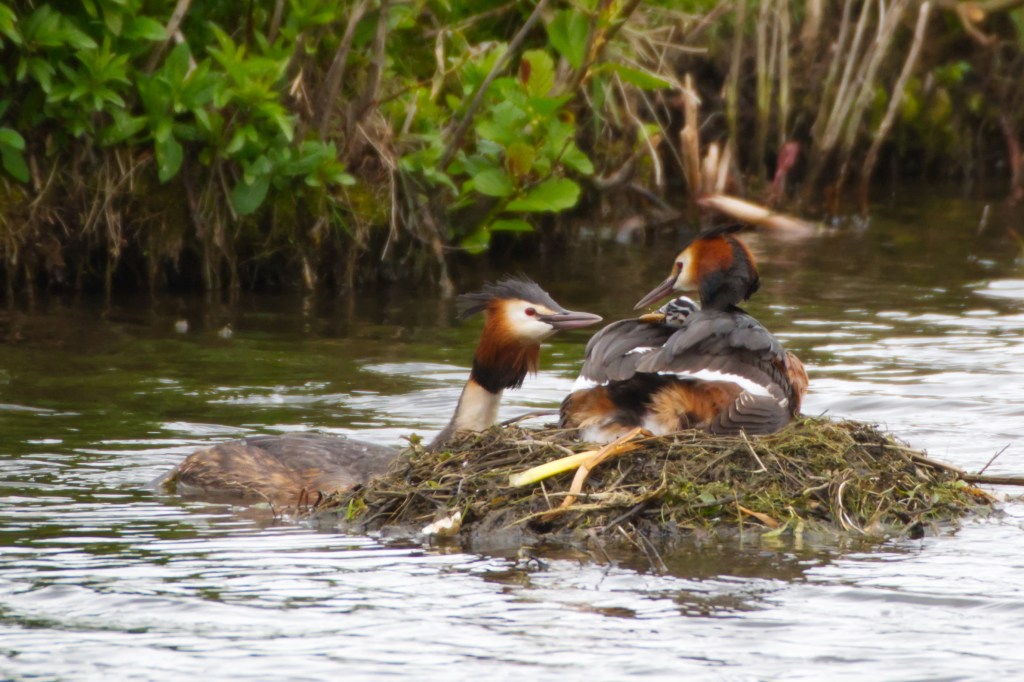
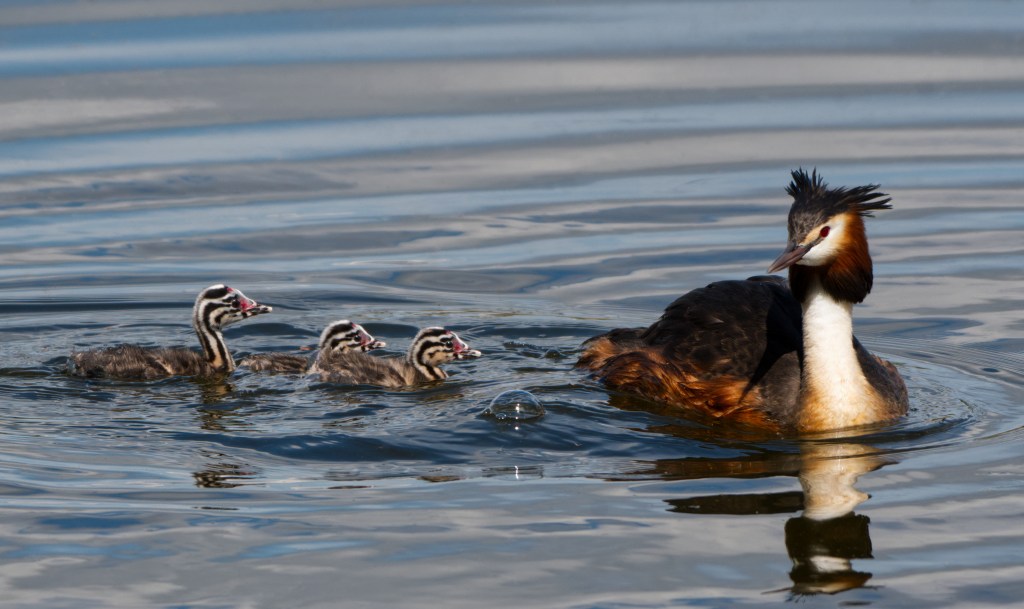
When chicks emerge, they carry markings that look like moving reflections of reed shadow and water glare. Bold stripes trace their heads and necks, breaking their outline into fragments that belong more easily to shifting light than fixed sight. They are capable of swimming almost immediately. There is no extended transition between land and water life. The lake is not introduced gradually. It is immediate context.
Yet independence is not immediate. Chicks remain tightly associated with adults, moving in close formation that reduces exposure and increases survival. What emerges is not a dispersal of young but a compact unit of movement within the lake.
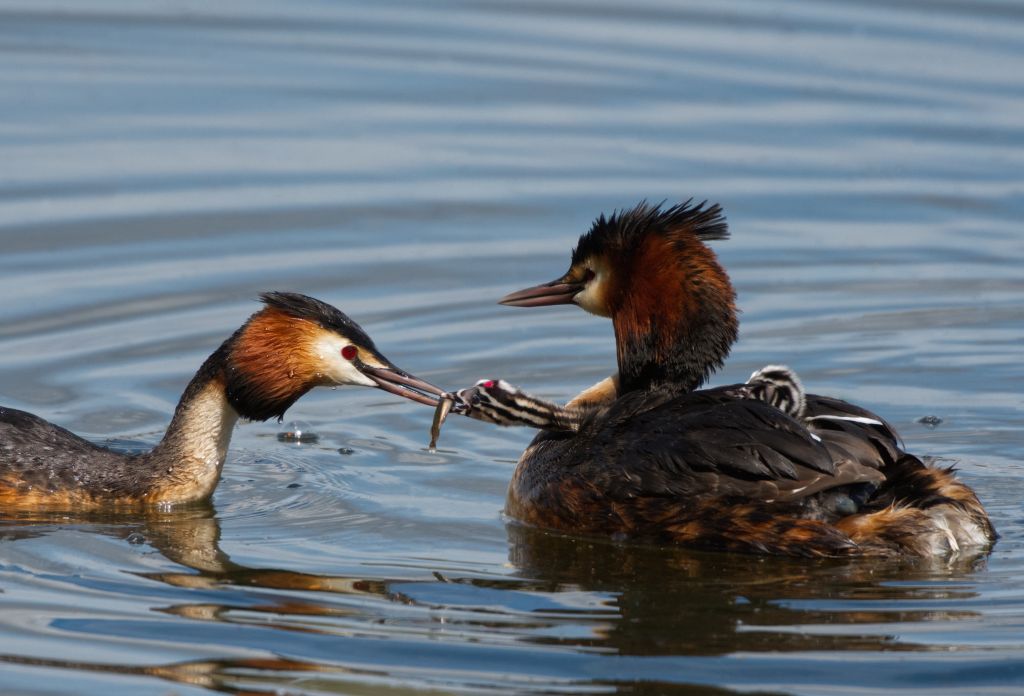
This is not a static refuge. As the adult dives, the surface breaks and reforms. Chicks may briefly enter water before returning to the back again, adjusting each time to the lake’s interruption of certainty. The effect is a layered presence. One body moving through water while carrying another life just above it.
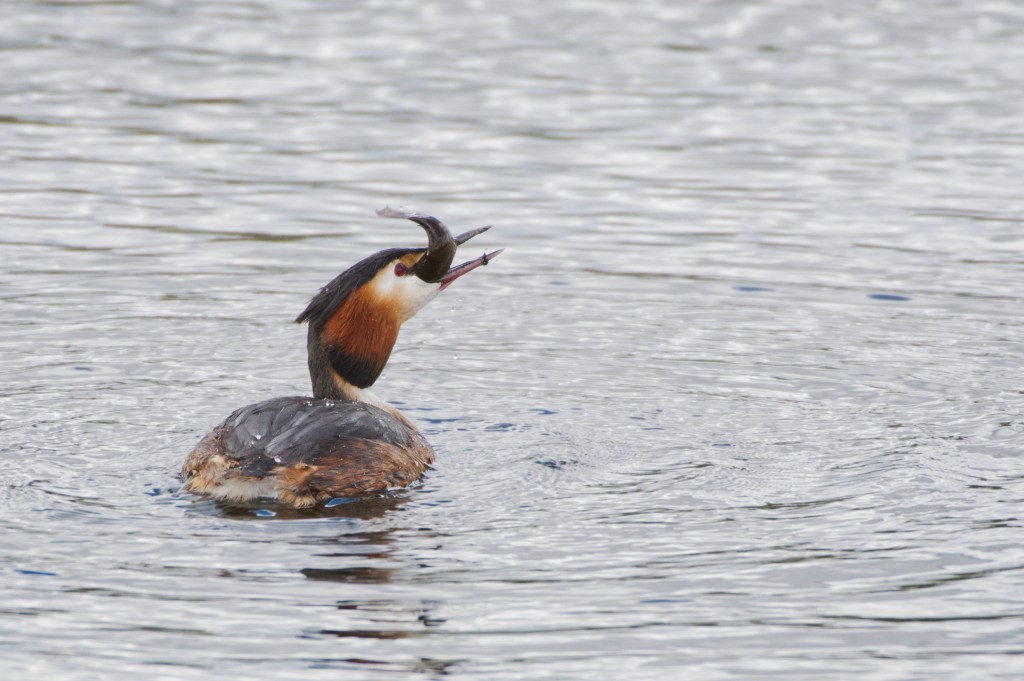
The grebe hunts by disappearance. It lowers its head, then vanishes beneath the surface without warning. The water closes behind it and offers no trace of direction. This behaviour repeats across open water and reed edges. The bird reappears elsewhere, sometimes close, sometimes distant, as if the lake has redistributed it.
Prey consists mainly of small fish and aquatic invertebrates. These are brought back to chicks at the surface, where feeding becomes a meeting point between depth and air. Occasionally feathers are offered to chicks and swallowed. Field observation suggests this may assist in digestion, though the reason remains partly within the bird’s own logic of survival.
At Lackford Lakes, grebes make clear that water is not background but structure. Every aspect of their life depends on its surface, depth, and change. Reed beds provide edges, but water provides continuity. Nesting, feeding, raising young, and movement all occur within this single medium. The land exists as boundary only. The lake is the full field of action.
From courtship exchanges on spring mornings to the carrying of chicks across rippling surfaces, its life is written in movements that belong to the lake itself.
To follow it along the edges of Lackford Lakes is to read water as text, where each ripple holds a brief line of ongoing narrative, and each disappearance beneath the surface is part of the same longer sentence.
 The Footstep Chronicles
Leave a comment