
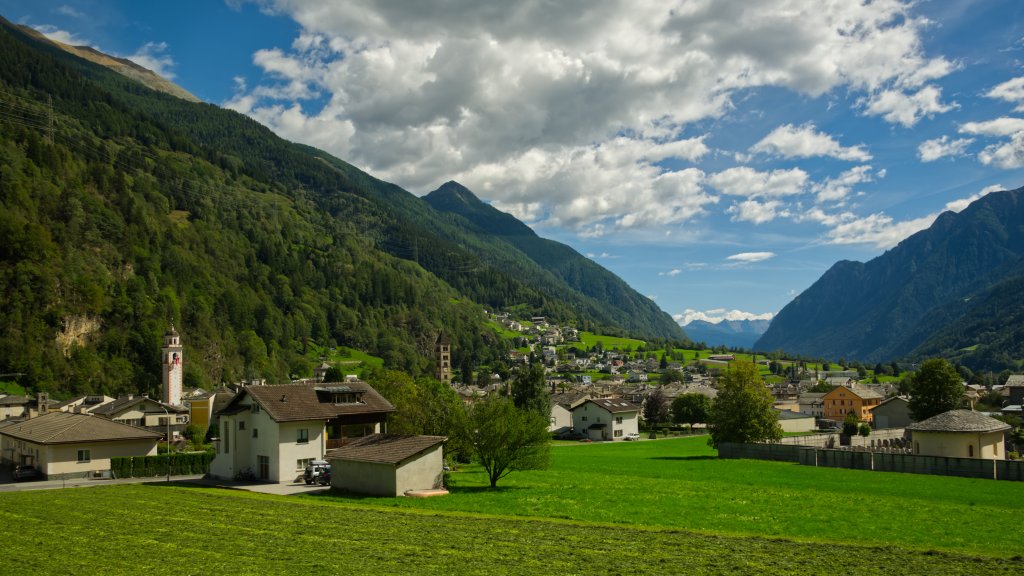
The journey from Tirano to St. Moritz follows a remarkable passage through the Alps, climbing from the Italian side of the mountains into Switzerland and through a succession of valleys, forests, lakes, glaciers and high mountain landscapes. From the warmth and lower elevations around Tirano, the railway steadily finds its way upwards, crossing bridges, curling around mountainsides and passing through places where the valley narrows to little more than a corridor for the tracks and road. Along the way, the scenery changes constantly, from the lower Valposchiavo to the high Alpine world around the Bernina Pass, before descending again towards Pontresina and the shores of St. Moritz.
The journey begins at Tirano, the southern end of the Bernina Line, where the mountains are already rising around the town. There is no long prelude in which the landscape gradually transforms. The railway leaves Tirano and within roughly two kilometres crosses the border into Switzerland at Campocologno, entering the Valposchiavo almost immediately. From the first minutes, the train is already committed to the mountains, following a route that was built to climb through terrain where every metre of elevation had to be carefully negotiated.
Within only a couple of kilometres, the train crosses from Italy into Switzerland at Campocologno. Beyond Campocologno, the railway enters the Valposchiavo, where the track begins to climb and the valley tightens around it. At times, the railway and roadway share the same narrow corridor, with both forced to follow the contours of the valley where there is little room for either to stray. The landscape is already Alpine, with steep slopes rising on either side and the railway finding a path through terrain that leaves little room for straight lines.
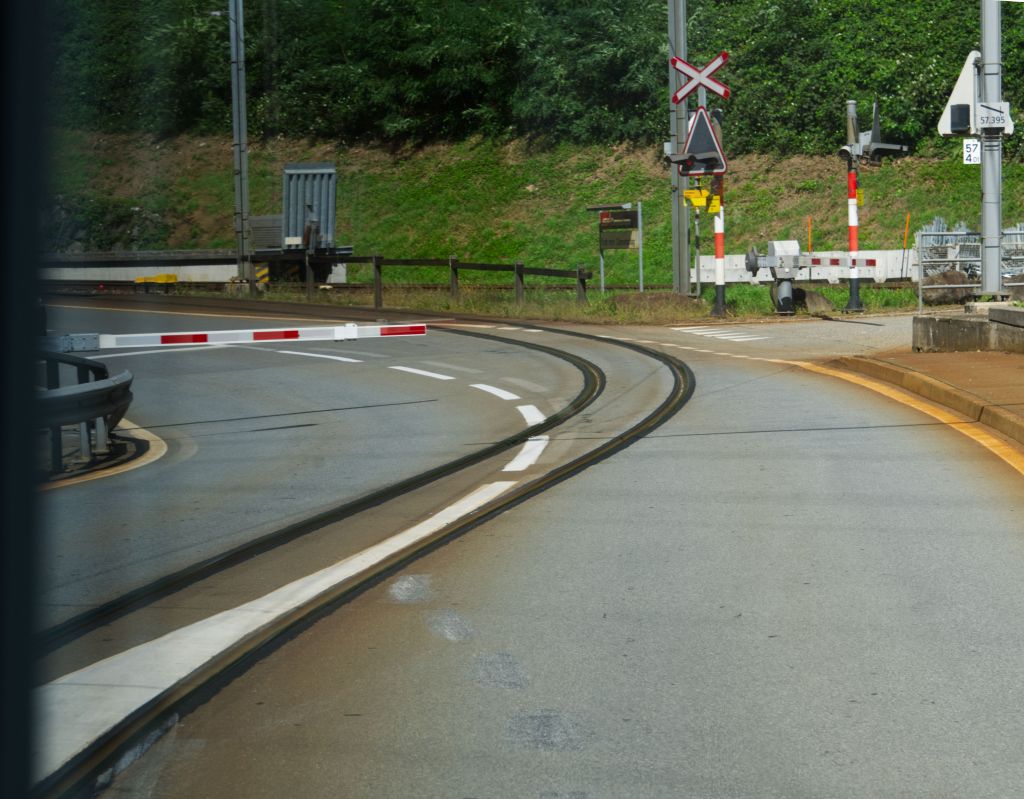
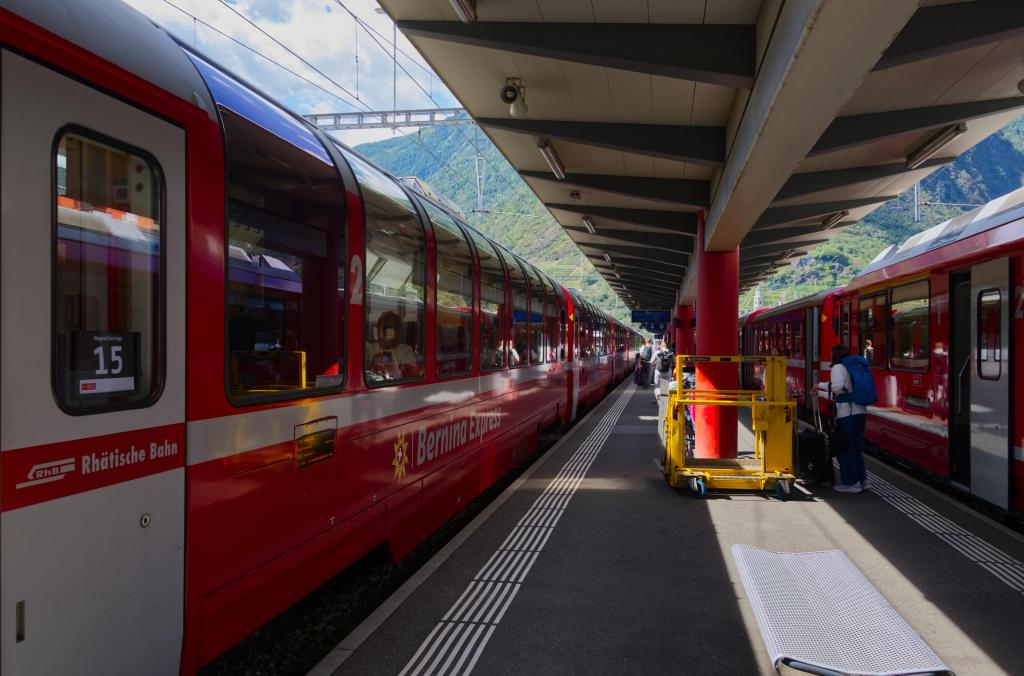
This is the same railway line made famous by the Bernina Express. The difference is the train service, not the route. The regular trains travel the Bernina Line between Tirano and St. Moritz, following the same extraordinary sequence of valleys, viaducts, mountain lakes, glaciers and high Alpine landscapes that has made the Bernina Express internationally famous. For a traveller sitting beside the window, the mountains do not care which service is carrying the journey north.
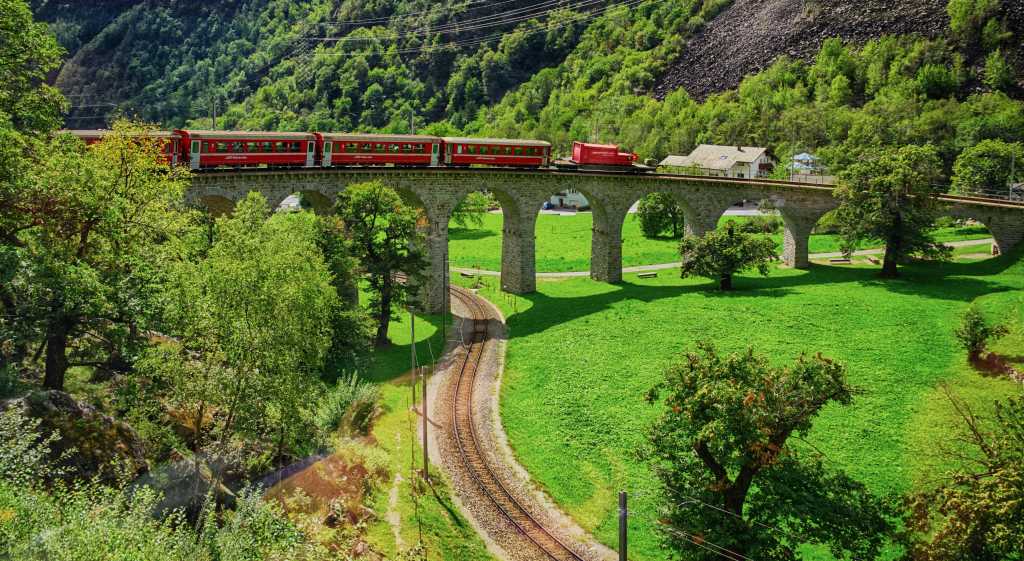
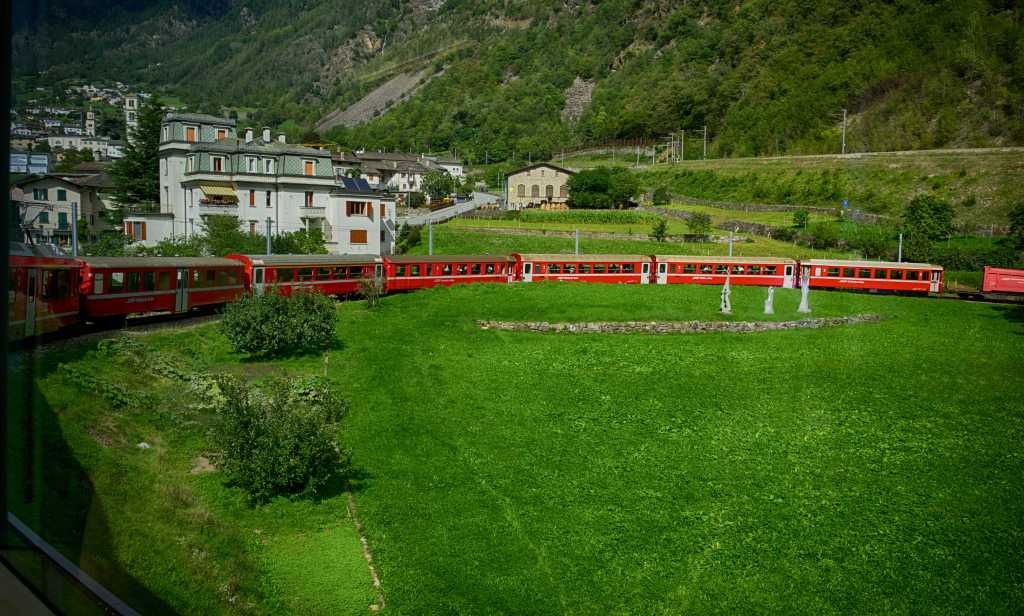
The first real landmark comes at Brusio, where the railway performs one of its most remarkable pieces of engineering. The Brusio Circular Viaduct curves through a sweeping loop, allowing the line to gain the necessary elevation within the confined space of the valley. As the train crosses the viaduct, the track seems to curl back towards itself, with the stone arches and surrounding mountains creating a scene that is almost difficult to understand until the railway begins to move through it.
There is something particularly satisfying about seeing the viaduct from the train because its purpose becomes apparent through movement. The railway does not simply cross a bridge to reach the other side of a valley. It uses the bridge as part of a carefully calculated climb, gaining height through the curve before continuing along the mountainside. The landscape dictates the route, and the railway responds with engineering that feels remarkably elegant rather than intrusive.
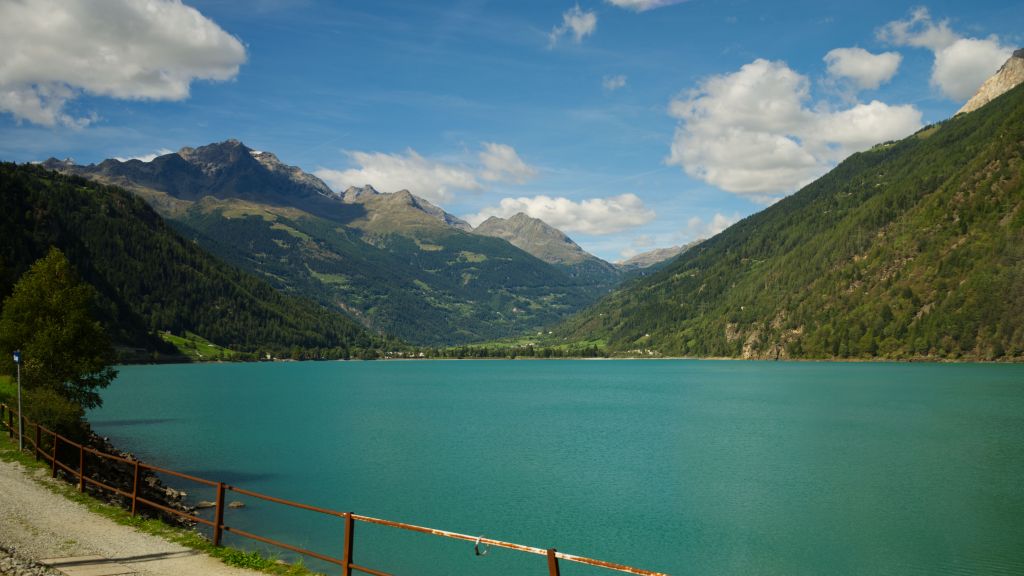
Beyond Brusio, the railway continues north through the Valposchiavo before reaching Lago di Poschiavo. The lake brings a welcome change to the enclosed valley, its calm waters opening a wider view beneath the surrounding mountains. The tracks follow the eastern shore near Le Prese, with the water appearing between the trees and slopes as the train continues towards Poschiavo and the higher country beyond.
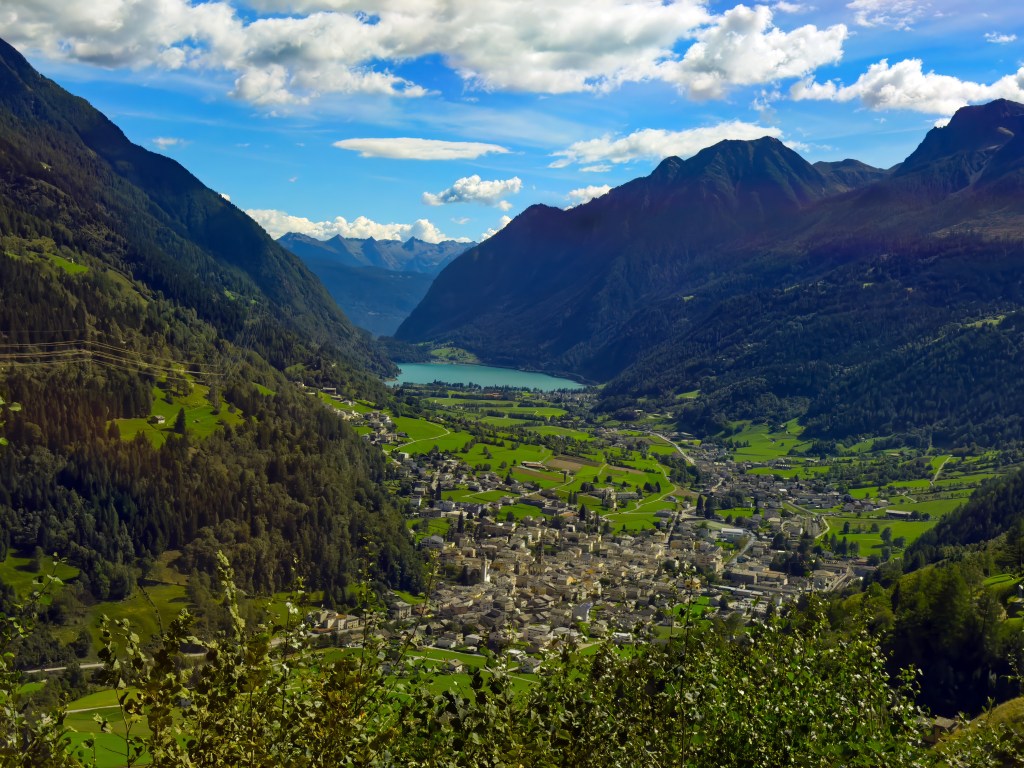
From Poschiavo, the railway begins to feel increasingly removed from the world below. The train continues upwards through forests and mountain slopes, while views back down the valley reveal how much elevation has already been gained. The villages become smaller from above, the valley floor seems farther away and the mountains begin to occupy more of the available sky.
One of the pleasures of travelling this route is that the landscape does not need to be announced. There are no artificial moments designed to tell passengers that something spectacular is about to appear. Instead, the railway simply continues climbing, and the scenery becomes increasingly dramatic because of the altitude. The ordinary details of the valley gradually give way to a landscape in which mountains, rock, water and sky become the dominant elements.
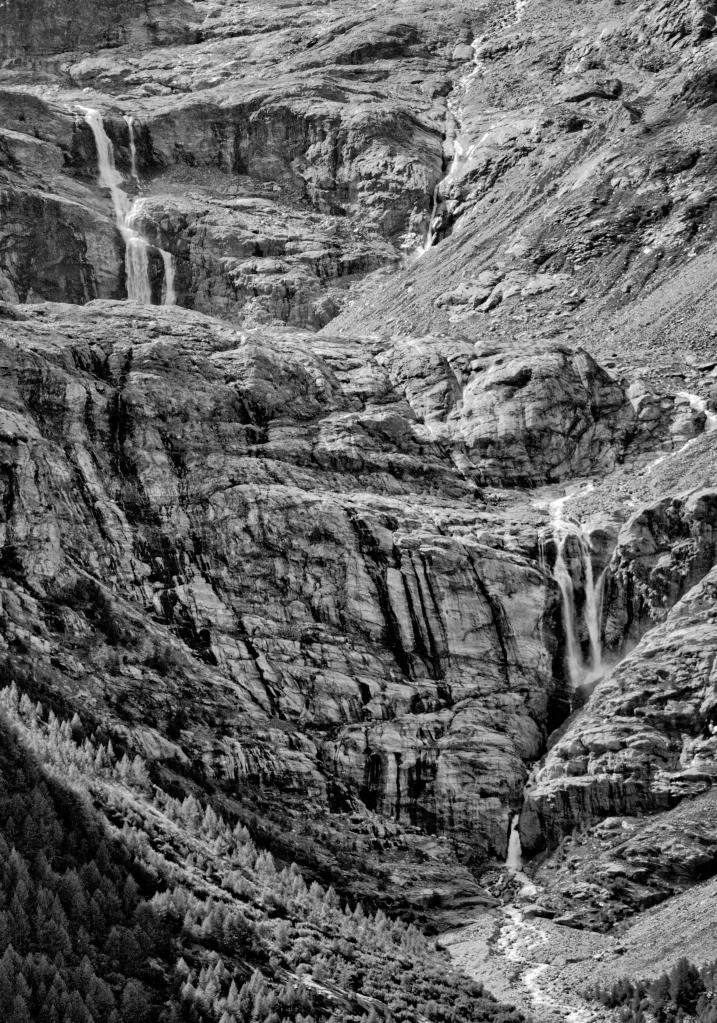
The higher the railway climbs, the more the landscape begins to shed the vegetation and settlement of the lower valley. Forests become less dominant, open slopes take over and exposed rock becomes increasingly visible. Snow remains on the higher peaks, while the railway continues through a landscape shaped by glaciers and the severe conditions of the high Alps.
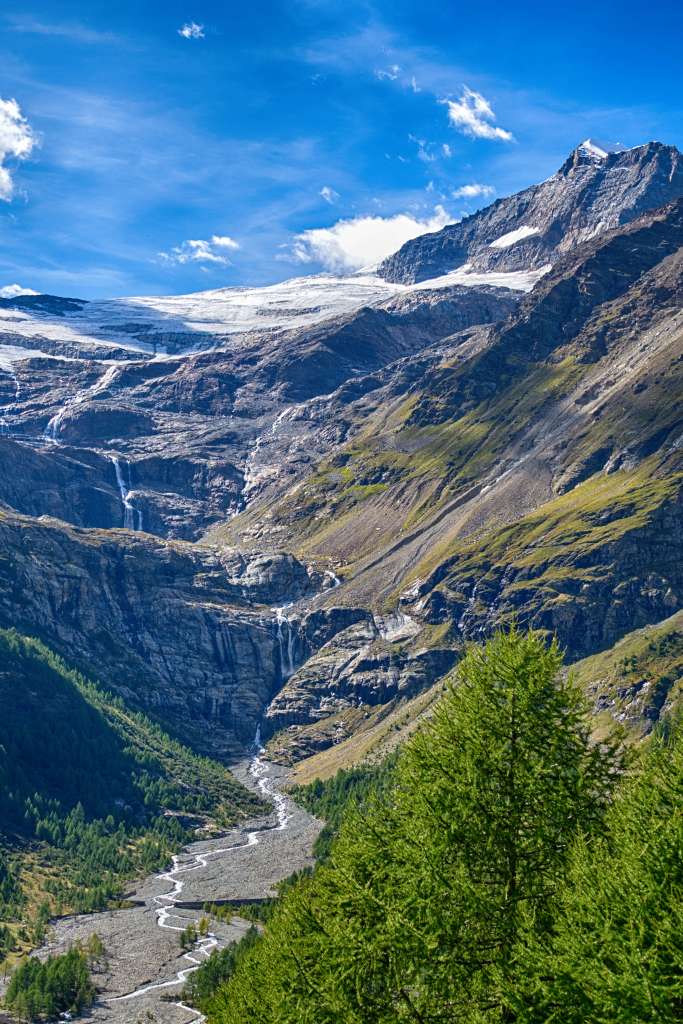
The train eventually reaches Alp Grüm, one of the great viewpoints on the route. From here, the landscape opens towards the Palü Glacier and the Bernina massif, while the Valposchiavo stretches away below. The position of the railway makes the scale of the mountains particularly striking because the train is high enough to look across the valley rather than simply up at the surrounding slopes. The glacier and peaks beyond it give the scene a sense of depth that is difficult to appreciate from the lower sections of the journey.
For the traveller, this is where the journey becomes particularly demanding. The train provides an ever-changing series of compositions, but nothing remains still long enough to be taken for granted. A glacier can appear between two slopes, a lake can flash into view below the track or a mountain can emerge from behind a curve before disappearing again almost immediately.
That uncertainty is part of the attraction. The scenery become fragments of movement, tied to the precise moment when the train happened to be in the right place. Some views last only seconds, while others remain long enough to absorb the details of the mountains, the light and the changing weather. The journey creates its own rhythm through those fleeting views, with the carriage windows continually moving the frame to something new.
Above Alp Grüm, the route enters the high Bernina landscape. The surroundings become increasingly open and exposed, with fewer trees and almost no sense of the settled valleys left behind. Mountains dominate the horizon, while glacial lakes and snowfields appear among the rock. The railway seems remarkably small in this environment, a narrow line crossing a landscape whose scale is measured in peaks and ridges rather than buildings and roads.
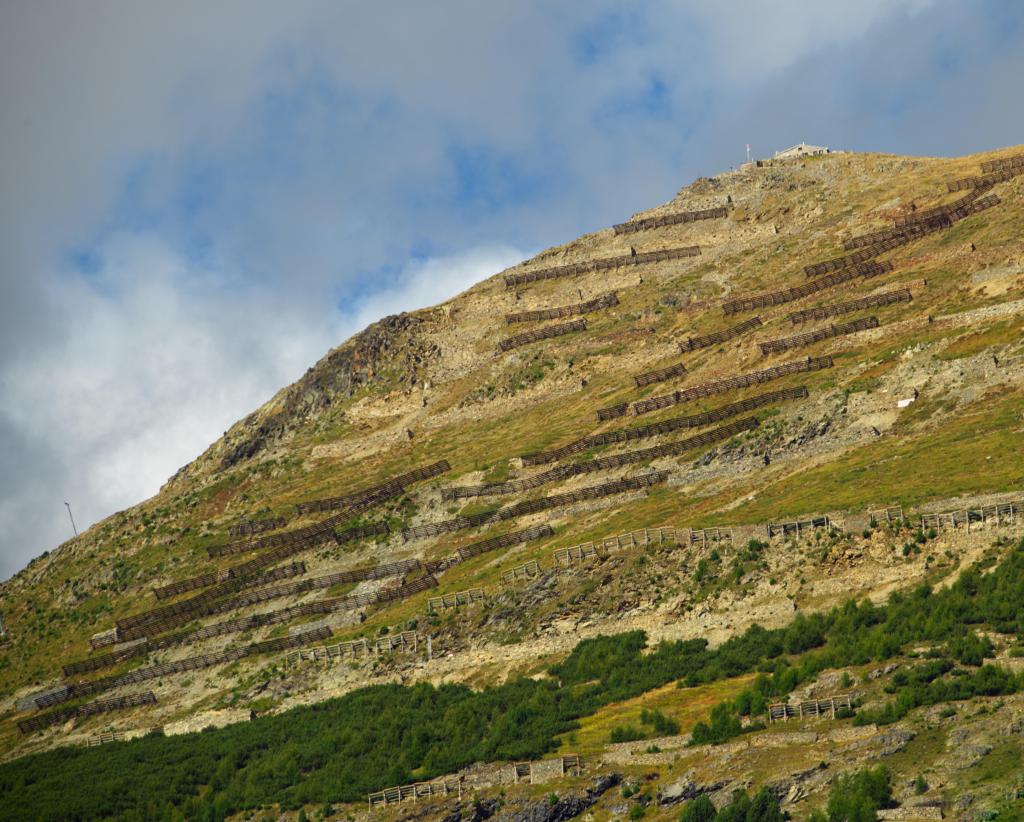
Eventually the train reaches Ospizio Bernina, at 2,253 metres above sea level, the highest point of the Bernina railway. The station sits beside the high Alpine landscape around Lago Bianco, where the water, mountains and sky create a much more austere scene than the green valleys below. The line has climbed from Tirano through Brusio and Poschiavo, past Alp Grüm and into a landscape where the effects of altitude are written across every slope.
Lago Bianco is one of those places where the landscape seems to simplify itself. There are fewer buildings, fewer trees and fewer signs of human activity, leaving the eye to move between the water, the surrounding mountains and the snow that remains on the higher slopes. Depending on the weather, the lake can appear pale blue, silver or almost grey, reflecting the sky and giving the high country a sense of stillness even while the train continues moving.
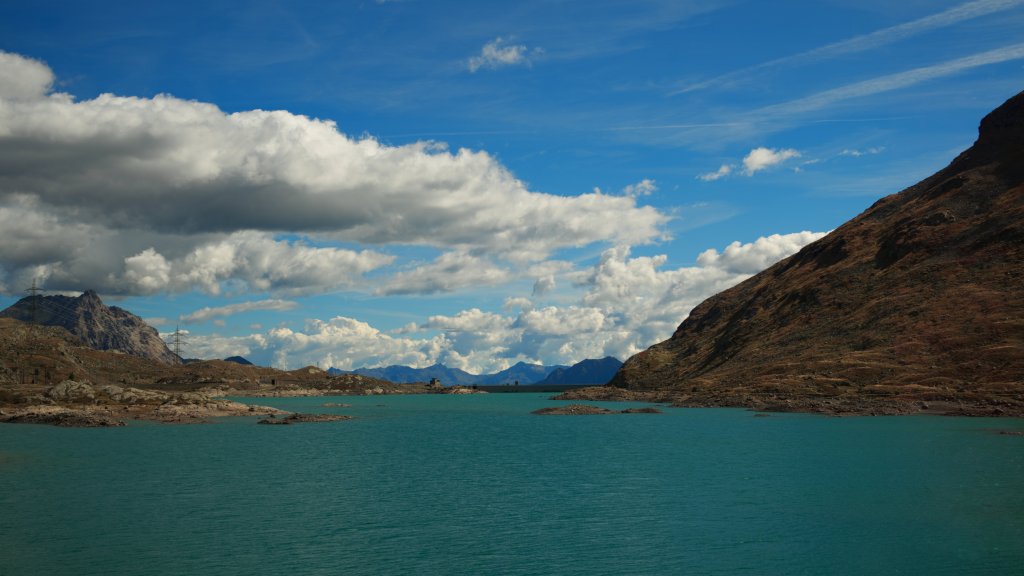
Looking out across the high Alpine landscape around Lago Bianco, it is easy to forget just how much the railway has already climbed to reach this point. From Tirano, at around 429 metres above sea level, the line has risen to Ospizio Bernina at 2,253 metres, gaining more than 1,800 metres in elevation without a rack railway or cogwheel system. Even on gradients reaching 70‰, the train relies entirely on the grip between its wheels and the rails. There is no toothed rail between the tracks for a cogwheel to engage with, yet the train continues steadily upwards into the high mountain landscape. For passengers watching from the window, the achievement is easy to overlook because the engineering is so neatly absorbed into the scenery.
The railway gains its height through a combination of curves, loops, viaducts and carefully calculated gradients, effectively making the route longer so that the train can climb without resorting to a rack system. The Brusio Circular Viaduct is the most obvious example, but the same principle continues much higher into the mountains. Even after the train reaches the Bernina high point and begins its descent towards Morteratsch, Pontresina and St. Moritz, there is still no change to a cogwheel system. The entire route remains an adhesion railway, carrying passengers from the Italian valley floor to one of the highest points reached by a railway of its kind in Europe, and then back down into the Engadin valley using nothing more than steel wheels, steel rails and an extraordinary piece of mountain engineering.
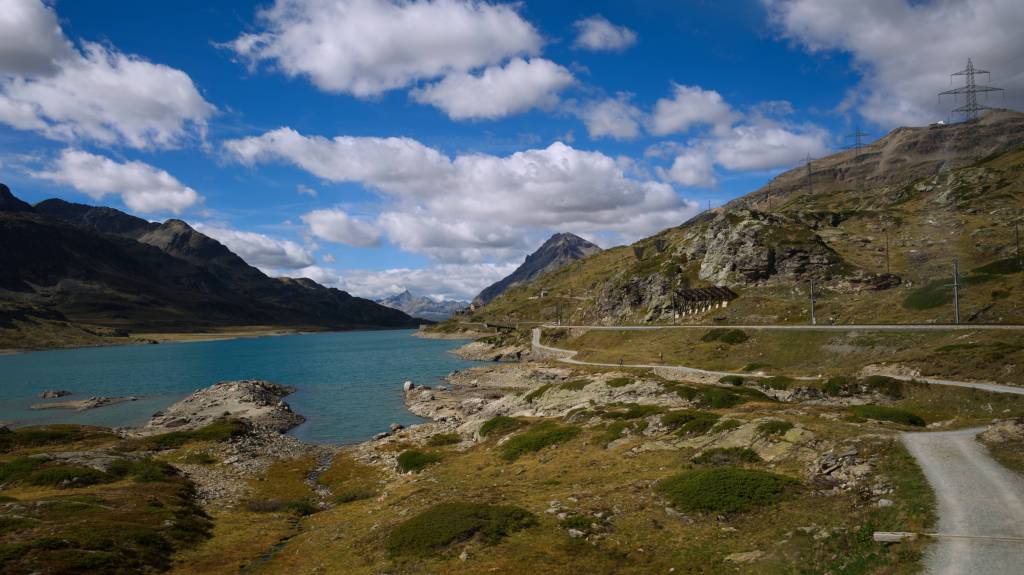
After the high point, the character of the journey begins to change again. The railway starts its descent towards the Engadin, and the starkness of the highest sections gradually gives way to more vegetation and broader mountain valleys. The descent does not diminish the scenery. Instead, it offers a different perspective, with the mountains now rising above the train while the route begins to reveal the landscapes of the Upper Engadin.
The Bernina massif remains an imposing presence, and the route passes the Morteratsch area, where the Morteratsch Glacier occupies the high landscape beyond the railway. The glacier is one of the defining features of this section of the journey, connecting the railway once again with the great glacial environment that has shaped the mountains around it. Beyond Morteratsch, the railway continues towards Pontresina, where the landscape becomes more open and settled.
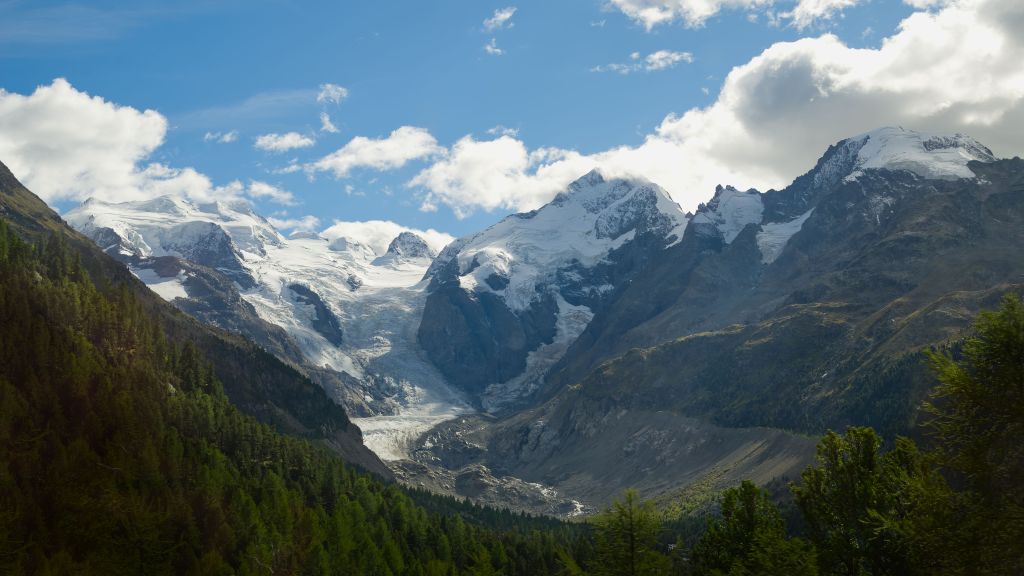
Pontresina sits high in the Engadin surrounded by forests, meadows and some of the most impressive peaks in the region. After the stark landscape around Ospizio Bernina, the return of trees and buildings provides a sense of shelter, but the mountains remain very much in control of the horizon. The railway has descended considerably, yet the altitude and scale of the surroundings still make it clear that this is high Alpine country.
From Pontresina, the final section towards St. Moritz passes through the broader landscape of the Engadin. Lakes and mountain slopes open around the railway, and the feeling becomes less one of climbing through a narrow mountain corridor and more one of travelling across a high valley surrounded by peaks. The landscape has changed once again, but the mountains remain the constant thread connecting the entire journey.
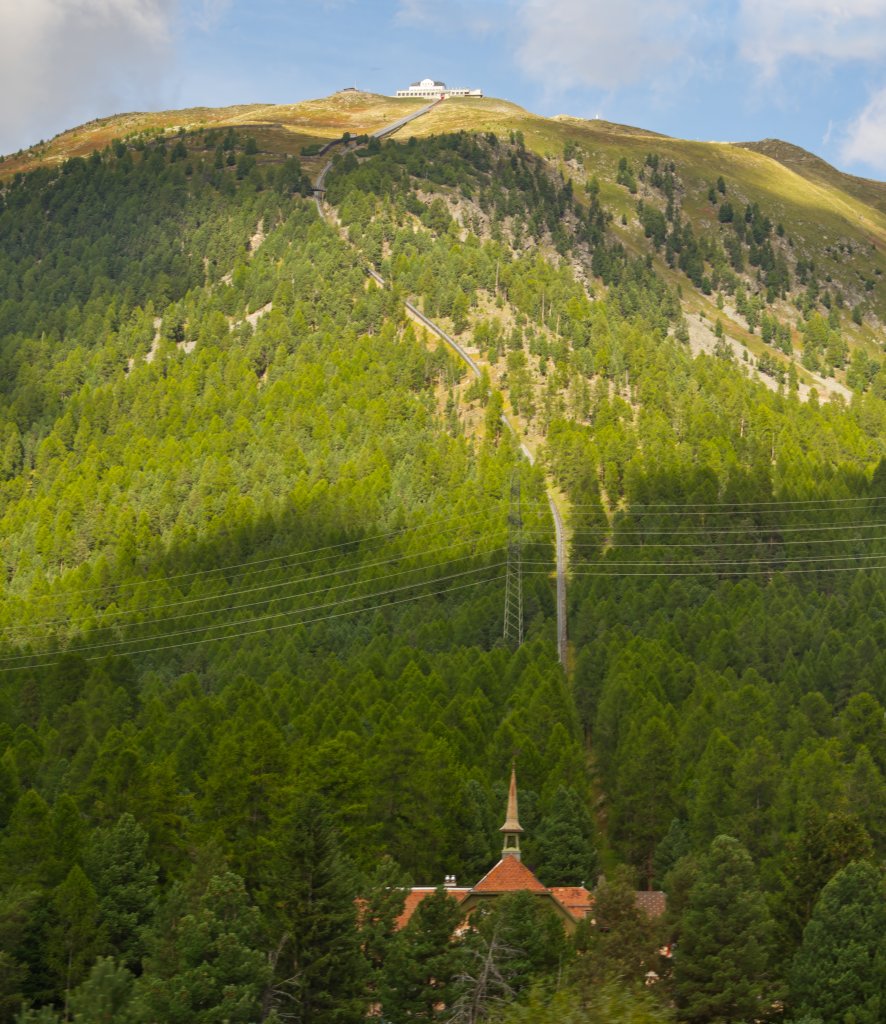
St. Moritz eventually comes into view at around 1,775 metres above sea level. The town sits within the Engadin landscape, surrounded by mountains and lakes, and its arrival marks the end of a remarkable journey that began far below at Tirano.
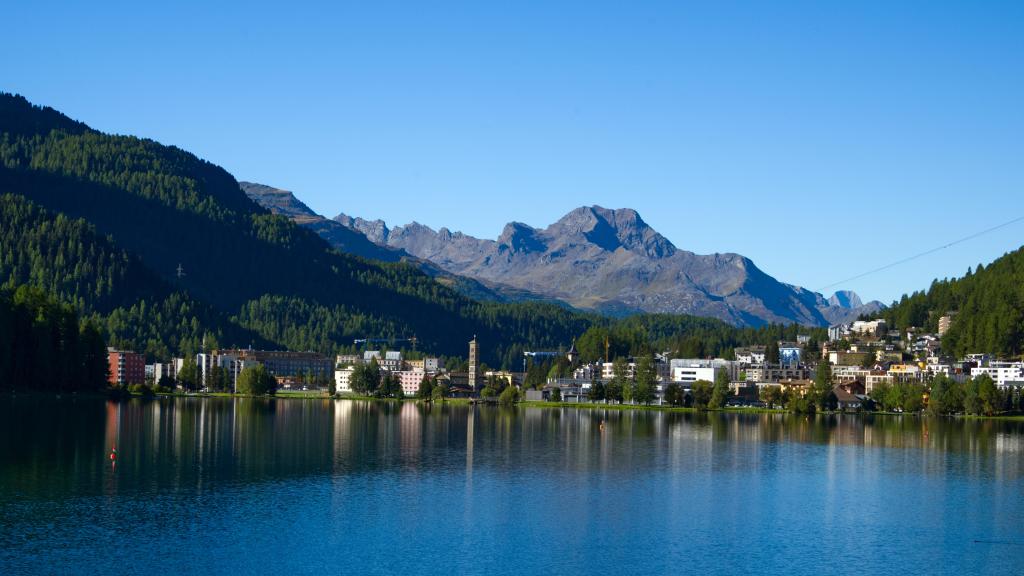
By the time the train reaches St. Moritz, the journey feels considerably longer than the distance on a map. Tirano seems far away, not because the railway has travelled an enormous horizontal distance, but because it has moved through such a remarkable succession of landscapes. The mountains have changed character repeatedly, from the steep valleys around Tirano and Brusio to the forests of Poschiavo, the glaciers around Alp Grüm and Morteratsch, the exposed high country of Ospizio Bernina and finally the open landscapes of the Engadin.
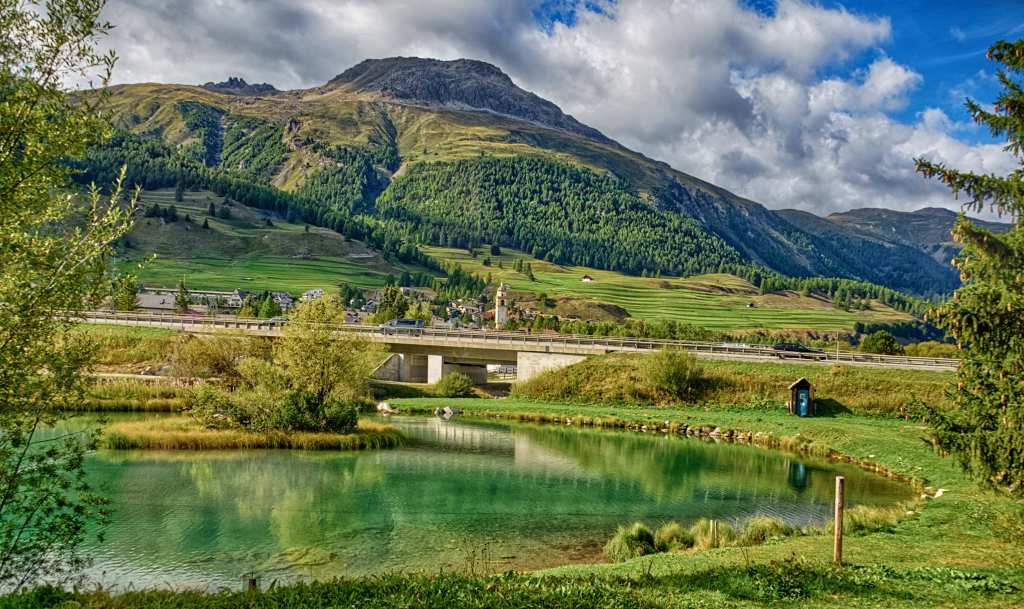
For the traveller, that continuity is perhaps the most rewarding part. The dramatic views naturally demand attention, but the quieter moments between them provide the sense of place. A small station surrounded by mountains, a distant village beneath a forested slope, sunlight falling across a glacier or the sudden appearance of a lake can become as memorable as the celebrated viaducts and peaks.
The railway itself becomes part of the visual story without needing to dominate it. At times the tracks are almost invisible beneath the train, while elsewhere they curve across a mountainside or emerge from a tunnel into an enormous panorama. The engineering is impressive precisely because it seems to belong there, following the shape of the landscape rather than trying to overpower it.
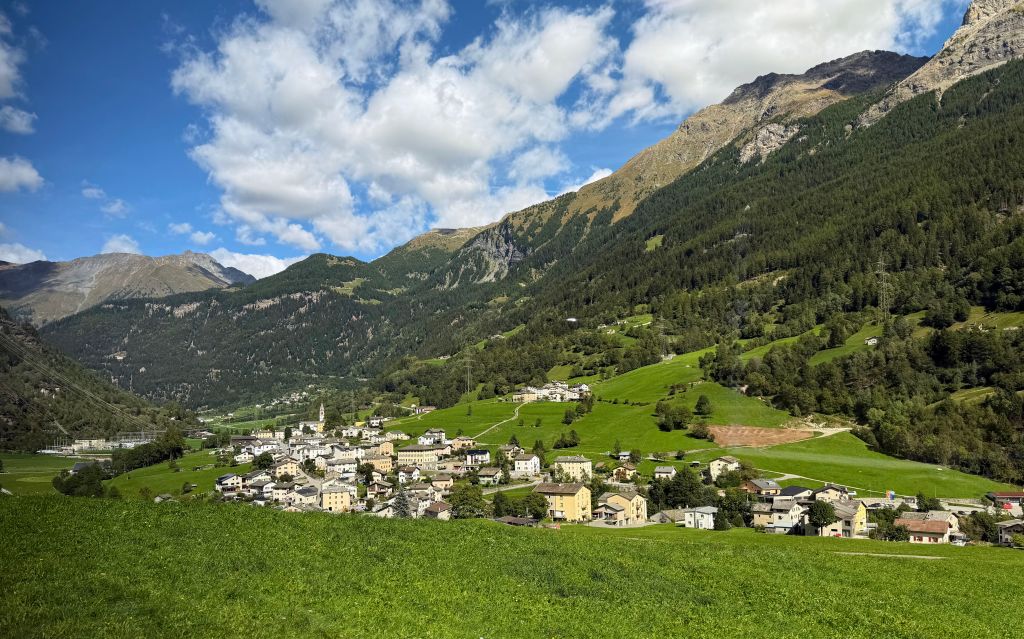
That is also what separates the journey from simply viewing the Alps from a single viewpoint. A mountain panorama gives one perspective, but the railway provides dozens. The mountains change position, the valleys open and close, glaciers appear and disappear, and the same peaks can look completely different as the train moves around them.
It is easy to describe the Bernina Line as one of the world’s great scenic railway journeys, but the phrase does not quite capture what happens from the carriage window. The real experience is not simply seeing spectacular scenery. It is watching an entire Alpine landscape reveal itself in stages, with every curve of the railway providing another chapter.
Outside the carriage windows, the landscape keeps changing, sometimes dramatically and sometimes almost imperceptibly, while the railway continues to find its way through the mountains. From Tirano to St. Moritz, it is not simply a train ride through spectacular scenery. It is a journey through the geography of the Alps itself.
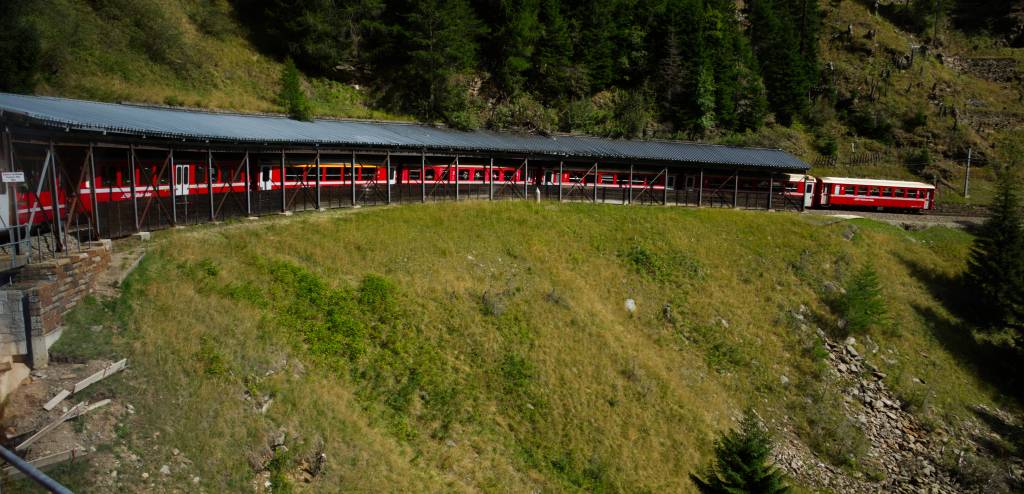
And perhaps that is the lasting image of the journey: the red train moving quietly through an enormous landscape, climbing where the mountains allow it and curving where the valley demands it. The railway climbs from the Italian valley floor and ending high in the Swiss Alps while reaching one of the highest points accessible by conventional rail anywhere in Europe.


Leave a comment